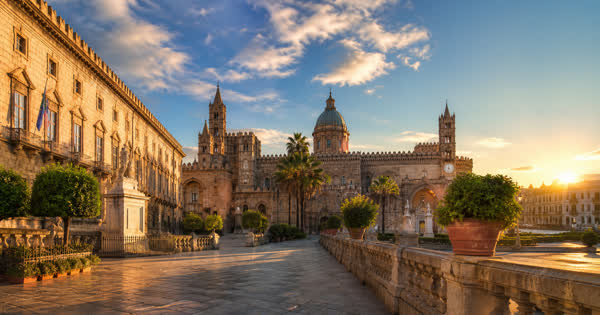
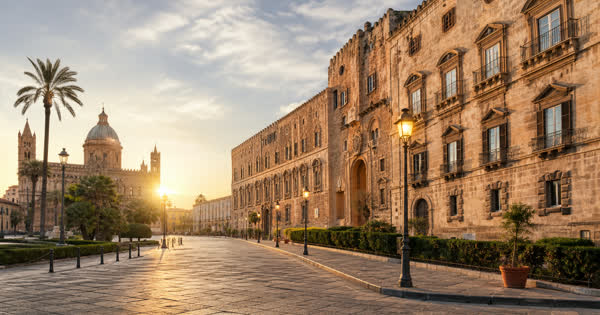
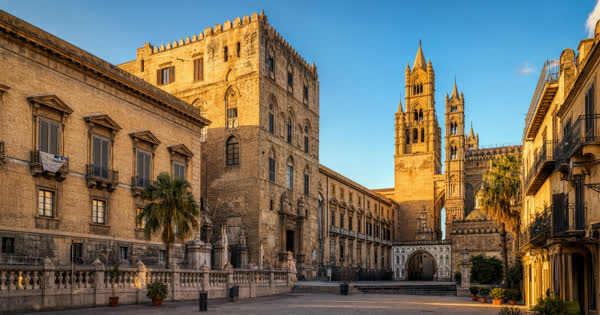
The Cassaro is the oldest street in Palermo. The name derives from the Arabic al-Qasr, the castle, because it led directly to the Royal Palace. Its layout dates back to the Phoenician era, over 2,700 years ago. Greeks, Carthaginians, Romans, Arabs, Normans, Spanish, all have traveled this same straight line. Today it is Corso Vittorio Emanuele. One of the few streets in the world whose layout has never changed in almost 3,000 years of continuous urban history.
Plays on location, in the app
Chiesa di San Cataldo - Piazza Bellini
38s
The church of San Cataldo was built around 1154 by the will of Maio of Bari, chancellor of the Norman kingdom. It is one of the purest examples of Arab-Norman architecture. Three red domes, square floor plan, no decorated interior. It remained a church for a short time. After the death of Maio of Bari, it was ceded to the Knights of Malta and used as a post office in the 1700s. Today it is deconsecrated. The building has never been structurally modified since the Norman era. What you see is exactly how it was built in 1154.
Plays on location, in the app
Chiesa della Martorana — Piazza Bellini
46s
The Church of the Martorana, officially Santa Maria dell'Ammiraglio, was built in 1143 by order of George of Antioch, grand admiral of the fleet of Roger II. It is one of the UNESCO monuments of the Arab-Norman route. Inside it preserves the original twelfth-century mosaics, among the oldest in Sicily. In 1194 the cession of the Kingdom of Sicily to the Swabians was signed here. In 1130 it was probably the place where Roger II received the title of king. The church takes its popular name from a convent of Benedictine nuns that occupied it in the Middle Ages. The same nuns who, according to tradition, invented the marzipan fruit in almond paste.
Plays on location, in the app
Mercato della Vucciria — Piazza Caracciolo
46s
The name Vucciria derives from the French word boucherie, which means butcher shop. In the Middle Ages this was the district of the slaughterhouse and meat sales, frequented by Genoese, Pisan, and Venetian merchants, thanks to its proximity to the port. Over time Vucciria became synonymous with confusion in the Palermitan dialect. In 1783 the viceroy Caracciolo had the central square reorganized with porticoes and a fountain with four lions. In 1974 painter Renato Guttuso immortalized this market in one of the most famous paintings of twentieth-century Italian art. Today the Vucciria is the capital of Palermo's nightlife scene.
Plays on location, in the app
Mercato di Ballarò — Piazza del Carmine
33s
Vallarò is the oldest and largest market in Palermo. Its origins date back to the 10th century, during Arab rule. The name probably derives from the Arabic Suq al-Balara, from the name of a village in Monreale from which gardeners arrived. Come early in the morning for street food, kha bread, meusa. The sandwich with boiled and fried spleen is the most typical. It costs less than 3 euros. If you want it without cheese it's called schetto, with cheese maritato. No menu will explain it to you, you need to already know it.
Plays on location, in the app
Piazza Pretoria — Fontana della Vergogna
39s
The great fountain at the center of this square was not designed for Palermo. It was commissioned by sculptor Francesco Camigliani in 1554 for the Florentine villa of the Viceroy of Naples, Don Pedro Alvarez de Toledo. When the viceroy's son found himself deeply in debt, he put it up for sale. The senate of Palermo purchased it in 1573 and had it dismantled into 644 pieces, transported by sea, and reassembled here. Palermitans immediately called it the Fountain of Shame because of the numerous nude statues. The name was a scandal. It has remained so forever.
Plays on location, in the app
Quattro Canti — Piazza Vigliena
42s
The Four Corners are not a square, they are an intersection, the point where Via Macheda cuts across the Cassaro dividing Palermo into four historical districts. The corner buildings were constructed between 1608 and 1620 according to a design by Giulio Lasso, with decorations completed in 1663. Each façade has three levels, the fountains of the seasons on the first, the Spanish kings on the second, the patron saints of the four neighborhoods on the third. It is the only example in the world of an octagonal Baroque square created from a street intersection. Each level tells a different hierarchy of power, natural, royal, divine.
Plays on location, in the app
Chiesa di San Giovanni degli Eremiti — Via dei Benedettini
42s
San Giovanni degli Eremiti was built at the behest of Roger II between 1130 and 1148, on the site of a Gregorian monastery founded in the 6th century. The five domes, which make it unmistakable, are of Islamic craftsmanship, built by Arab workers in the service of a Norman king for a Christian church. In 1882 the architect Giuseppe Patricolo, during a restoration, discovered traces of an ancient plaster that he interpreted as deep red and had the domes covered with that intense color. Before 1882 the domes were not red. Palermo's most iconic symbol has had that color for less than 150 years.
Plays on location, in the app
Cattedrale di Palermo — Prima colonna sinistra del portico
34s
Enter the southern portico of the cathedral and look at the first column on the left. Sculpted on it is verse 54 of sura 7 of the Quran, the sura of Limbo, which reads: He covers the day with the veil of night that eagerly pursues it, and the sun and the moon and the stars He created subject to His command. The column comes from the ancient Arab mosque that occupied this site in the ninth century. The Normans did not destroy it. They reused it. The Islamic verse has been there for over 900 years, at the entrance of a Christian cathedral.
Plays on location, in the app
Cattedrale di Palermo — Corso Vittorio Emanuele
40s
The Cathedral of Palermo was built in 1184 at the behest of the Norman archbishop Walter Opard, on the same site where a 5th-century paleo-Christian church once stood, transformed into a mosque by the Arabs in the 9th century. The current structure is the result of over eight centuries of overlapping modifications, Gothic-Catalan, Aragonese, Baroque, and Neoclassical. The dome you see today was added by Ferdinando Fuga between 1781 and 1801. Inside are buried the Norman and Swabian kings of Sicily, including Frederick II of Swabia and Roger II.
Plays on location, in the app
The full story plays on location, in the appLocation-based audio on Voxter