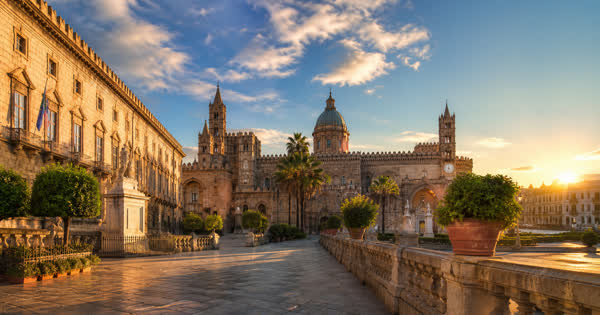
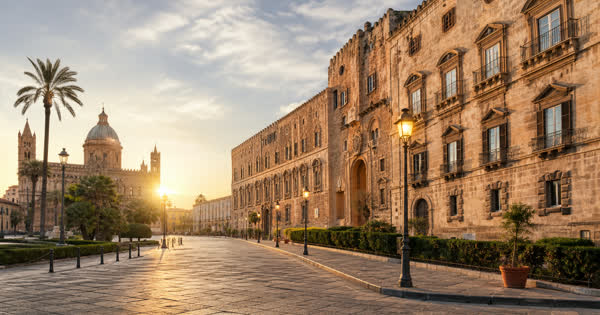
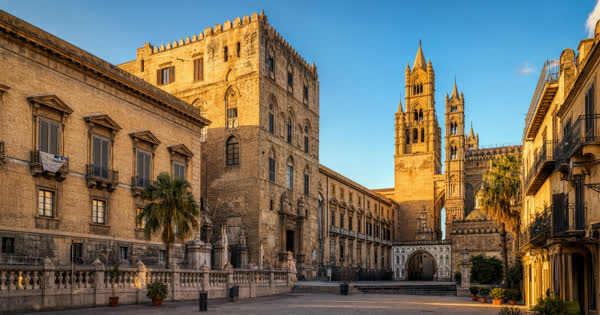
Do you know that the Cathedral of Palermo hides an astronomical secret? On the floor of the nave is engraved a meridian line, a true scientific instrument desired in the eighteenth century to measure the motion of the sun. At noon, a ray of light filters through a hole in the vault and strikes exactly that line, indicating the day of the year with absolute precision. But that's not all: beneath your feet rest the remains of Norman and Swabian kings, including Frederick II. A cathedral that is at the same time a church, an observatory and a royal tomb. Where else could you find all of this in a single building?
Plays on location, in the app
Cattedrale di Palermo
38s
We are facing one of the most stratified monuments in Italy. The Cathedral of Palermo was built in 1185 by the will of Archbishop Walter Offamilio, but the ground on which it stands preserves centuries even more remote: here stood first an early Christian basilica, then transformed into a mosque by the Arabs in 831. The Normans restored it to Christian worship, and from then on every domination left its own mark. In the crypt rest the remains of Roger II, the first king of Sicily, and Emperor Frederick II of Swabia. A building that is not only a church: it is the living memory of a contested and magnificent island.
Plays on location, in the app
Porta Nuova — Corso Vittorio Emanuele
38s
Porta Nuova was built in 1535 to celebrate the triumphant return of Charles V from Tunis. The upper loggia with the telamons, the male figures that replace the columns, was added in 1669 after an accidental explosion that destroyed the original structure. Walk under it and look at it from the inside. From here begins the final stretch of the Cassaro towards the Palace of the Normans. From its summit, however, you can see Vittorio Emanuele in perspective, with the cathedral in the background. It is the exact point where the medieval city ended and royal power began.
Plays on location, in the app
Teatro Massimo di Palermo — Piazza Verdi
44s
The Teatro Massimo is the largest opera house in Italy and the third largest in Europe, after the Paris Opera and the Wiener Staatsoper in Vienna. It was designed by Giovanni Battista Filippo Basile in 1875 and completed by his son Ernesto in 1897. It took 22 years. On the pediment is inscribed the phrase of Pericles, "Art renews peoples and reveals their life to them." After its inauguration, it was closed for restoration in 1974 and remained closed for 23 years, until 1997. That closure became a symbol of Palermo's institutional paralysis. The reopening coincided with the season of the city's maximum commitment to fighting the mafia.
Plays on location, in the app
Via dei Beati Paoli — Quartiere Capo
36s
Via dei Beati Paoli takes its name from a medieval Palermitan secret brotherhood, the Beati Paoli, who according to tradition would meet at night in the catacombs beneath the capo district to judge corrupt nobles and unjust powerful men. It is said that the condemned would be abducted at night and made to disappear without a trace. There is no certain historical evidence of their existence, but the novelist Luigi Natoli made them the protagonists of the most famous Sicilian historical novel, published in 1909. The street still bears their name, and the district has never forgotten them.
Plays on location, in the app
Piazza Marina — La Cala
33s
Piazza Marina is the largest square in Palermo's Historic Center. At its center is the Garibaldi Garden, with the oldest magnolia figs in Italy. Some are over 150 years old and have aerial roots that descend from the branches like tentacles. It is said that the roots have lifted the surrounding pavement over the decades. Sit on a bench under these trees early in the morning and watch the square wake up. A few steps away is the Cala, Palermo's ancient Arab port, still active with fishing boats.
Plays on location, in the app
Oratorio del Rosario di Santa Cita — Via Valverde
37s
The oratory of Santa Cita is considered the absolute masterpiece of Giacomo Serpotta, the Palermitan stuccoworker who between 1687 and 1718 covered the walls with white stucco featuring scenes of the Battle of Lepanto, angels, putti and allegories. Serpotta worked with such refined stucco that it seemed like marble or ivory. It is said that he added milk to the mixture to obtain that luminosity. He never revealed the formula. His works in Palermo are considered unique in the world for technique and quality. This room is his absolute peak.
Plays on location, in the app
Palazzo Abatellis — Via Alloro, Kalsa
37s
Palazzo Abatellis was built at the end of the fifteenth century for Francesco Patella, master portolan of the Kingdom of Sicily. It is a rare example of Catalan Gothic in Palermo. Since 1954 it has housed the Regional Gallery of Sicily. It preserves the Triumph of Death, a fifteenth-century fresco detached from the wall of Palazzo Sclafani. A work by an unknown author, considered one of the masterpieces of European medieval art. It also preserves the bust of Eleanor of Aragon by Francesco Laurana, which critic Federico Zeri defined as the most beautiful female portrait of the Italian Renaissance.
Plays on location, in the app
Quartiere Kalsa — Piazza della Kalsa
40s
La Qalsa was founded by the Arabs in the 10th century as a district reserved for the Caliph's troops. Al-Khalisa in Arabic means "the pure, the chosen one." For centuries it was the richest and most powerful district of Palermo. The Normans made it the center of aristocracy. Then came the invasions, the bombardments of 1943 that razed it almost to the ground and decades of abandonment. Today it is the most vital district of the historic center, with noble palaces still partially in ruins next to art galleries and venues. La Qalsa tells the entire history of Palermo, the glory, the destruction and the slow rebirth.
Plays on location, in the app
Mercato del Capo — Via Porta Carini
35s
The Capo Market extends beneath a long tunnel of colored fabrics that filter the light and create an almost cinematic atmosphere. It is the Fish Market par excellence in Palermo, with lobsters, sea urchins, swordfish, and octopuses displayed on marble counters. The vendors still practice the bagnata, the rhythmic cry-singing with which they call customers. Enter from Porta Carini, the fourteenth-century gate that is still its main entrance, and walk to the end. The Market ends in front of the Cathedral.
Plays on location, in the app
The full story plays on location, in the appLocation-based audio on Voxter