Sofia is one of the most affordable capitals in Europe, a city that surprises visitors with the density of history layered within just a few square kilometers of its center. Roman ruins surface beneath the streets and in metro stations, and medieval churches survive surrounded by 20th-century buildings. Vitosha Boulevard is the main pedestrian street of Sofia. From its intersection with Tsar Osvobodetel Boulevard, you can see in perspective Mount Vitosha, the extinct volcano that dominates the city at 2,290 meters above sea level. In summer it retains snow until May. It is one of the few European capitals with a ski mountain 30 minutes from the center. The boulevard is lined with cafes, shops and restaurants and is the evening meeting point for Sofia residents. Starting from Vitosha Boulevard on foot, you can reach the Rotunda of Saint George, the Basilica of Saint Sophia, the Alexander Nevsky Cathedral, and the National Museum in less than 15 minutes, the entire history of the city within a radius of just a few hundred meters.
Plays on location, in the app
Boyana Church
51s
The Boyana Church, located in the neighborhood of the same name to the south of the city center, has been a UNESCO World Heritage Site since 1979. It is a medieval church belonging to the Bulgarian Orthodox Church. The eastern wing of this two-story building was originally erected at the end of the 10th or beginning of the 11th century, while the central section was added in the 13th century, during the Second Bulgarian Empire. Inside the central section, built in 1259 at the behest of the Boyar Kaloyan, are frescoes from 1259 of extraordinary quality, considered among the most important examples of medieval Bulgarian and Balkan painting. The 1259 frescoes depict 89 scenes with 240 human figures, and are remarkable for the realism of their faces, rare for the period. The church stands on the slopes of Mount Vitosha, about 8 kilometers from the center of Sofia.
Plays on location, in the app
National Archaeological Museum
52s
Sofia has been the capital of Thrace, a Roman city named Serdica, so beloved by Emperor Constantine the Great that he considered making it the seat of the Empire instead of Byzantium, then a medieval Bulgarian settlement, and finally an Ottoman capital of the Balkans for almost five centuries. The National Archaeological Museum is housed in the former 15th-century Ottoman Grand Mosque, the Boyuk Kamei, built by the Turks after their conquest of the city in 1382. It was the first mosque built in Sofia after the Ottoman conquest, following Bulgarian liberation in 1878, it was converted into a museum. The Ottoman building now houses the most important collection of Bulgarian antiquities, Thracian, Roman, medieval and proto-Bulgarian artefacts. Among the most extraordinary pieces are the Thracian gold treasures, some of the oldest and finest goldwork of the ancient world.
Plays on location, in the app
Saint Sofia Basilica
53s
During the Ottoman rule the Basilica of Saint Sophia was converted into a mosque and its frescoes destroyed. It was also struck by two earthquakes in 1818 and 1858, which caused even greater damage. It was then restored and definitively reopened to the public in 1998. Beside the Basilica lie the tombs of Bulgaria's national poet Ivan Vazov, and the politician Aleksandr Stambuliski, two of the most celebrated figures in modern Bulgarian culture. The Basilica gives its name to the capital of an entire country, yet for centuries it was a mosque, then abandoned, then struck by earthquakes. It has stood for over 1,500 years through Gothic, Hunnic, Byzantine, Bulgarian and Ottoman invasions. It was reopened to Christian worship only in 1998, less than 30 years ago. The city has borne its name for six centuries, but was only able to return to its own church in very recent times.
Plays on location, in the app
Saint Sofia Basilica
46s
The Church of Saint Sophia, the oldest in Sophia after the Rotunda of Saint George, is the place from which the city takes its name. Archaeological excavations have confirmed that the Church of Saint Sophia was built in the 4th century, on the remains of several earlier churches, and the necropolis of the city of Serdica. Excavations conducted beneath the basilica's floor in recent decades have uncovered the remains of four earlier religious buildings, superimposed on the same sacred site, dating back to the 4th century AD. Most of these remains can be visited through an underground pathway beneath the central nave. After the invasions of the Visigoths and Huns, Emperor Justinian built a church dedicated to the wisdom of God, the Greek meaning of Sophia. The inhabitants loved it so much that in the 14th century they decided to rename the city, calling it Sophia.
Plays on location, in the app
Rotunda of Saint George
37s
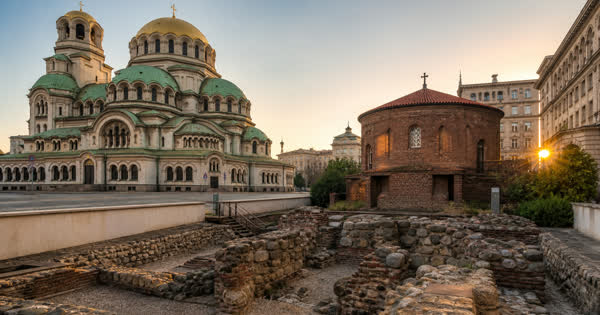
During the Ottoman occupation in the 16th century, the church was converted into a mosque. The frescoes on the dome were destroyed during the Ottoman rule. They were only discovered and restored in the 20th century. From 1895 until his burial in his own mausoleum in 1897, it served as the resting place of Alexander of Battenberg, the first prince of modern Bulgaria. The rotunda is literally hidden in the courtyard of a modern building, it cannot be seen from the street. You need to enter the courtyard of the Presidency of the Republic to find it. It is one of the best preserved Roman monuments in the Balkans, and very few tourists ever find it.
Plays on location, in the app
Rotunda of Saint George
50s
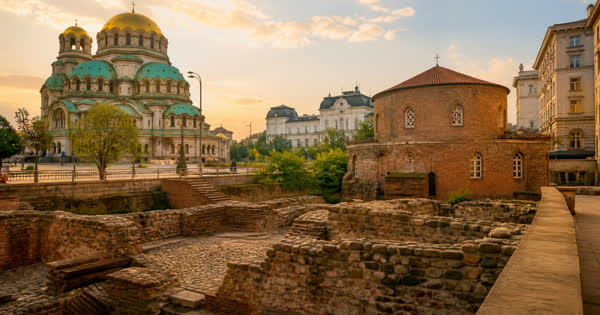
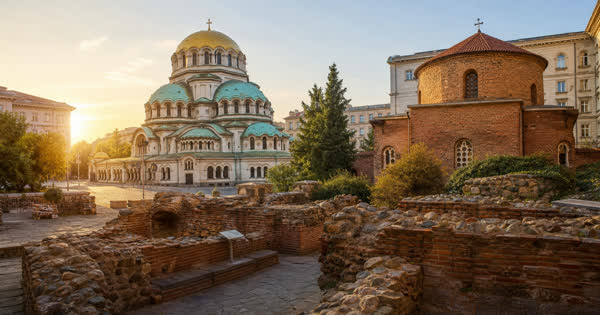
The Church of St. George is a circular early Christian church built at Serdica, the ancient name of Sophia. Built in red brick, it is considered the oldest building in the Bulgarian capital. The structure was erected by the Romans in the 4th century as a cylindrical domed building on a square base. Built as part of the imperial thermal complex of Roman Serdica, the city that Emperor Constantine I loved to call My Rome, the Rotunda is a circular red brick building 10 meters in diameter, topped by a dome that rises 14 meters. It is famous for its interior frescoes from the 12th, 13th and 14th centuries, of which three layers have been discovered so far. The church stands in the courtyard between the Balkan Hotel Sophia and the seat of the President of Bulgaria. The ground level of the church and the surrounding ruins is several meters lower than the current street level of Sophia.
Plays on location, in the app
Alexander Nevsky Cathedral Crypt
48s
The Crypt of the Cathedral, originally designed to house the tombs of Bulgarian sovereigns, is home to a museum of icons from across Bulgaria, and forms part of the National Gallery. It is the largest collection of Bulgarian icons in Europe. The exhibition displays over 200 icons dating from the 13th to the 19th century, three fragments of mural paintings, engravings, and other ancient religious artefacts. The oldest date back to the 13th century, among them, the Madonna of Hodeghetria, the only Bulgarian mosaic icon. From the following century, come the icons of Saint Michael and Saint Gabriel, from the Bakavo Monastery. The crypt is open separately from the church, Tuesday to Sunday, and is one of the most important museums of medieval religious art in the Balkans, almost unknown to Western tourism.
Plays on location, in the app
Alexander Nevsky Cathedral
1:02
The Alexander Nevsky Cathedral stands 45 meters tall. With its bell tower containing 12 bells, it reaches 50.52 meters. The cathedral covers an area of 3,170 square meters and can hold more than 5,000 people inside. It was dedicated to the Russian prince Alexander Nevsky because the cathedral was erected to commemorate the death of 200,000 Russian soldiers, who fell during the Russo-Turkish War of 1877–78, at the end of which Bulgaria obtained its independence. Construction resumed in 1904 and was completed in 1912, designed by Russian architect Alexander Pomerantsev. The iconostasis in white Carrara marble with onyx inserts stands 6 meters tall and 30 meters wide, and the baldachin above the high altar is gilded with gold leaf. During the First World War, in which Bulgaria fought against Russia, the church was rededicated to Saint Cyril and Methodius. Only in 1924 did it reclaim the name of Alexander Nevsky.
Plays on location, in the app
The full story plays on location, in the appLocation-based audio on Voxter