Look up: you're standing beside Sofia's Central Market Hall, on Boulevard Marie Louise. Locals just call it the Halite. Back in 1907, the city picked a design by architect Naum Torbov, and building took two years. The doors opened in 1911, and it still trades today. Spread over 3,200 square metres, it's widely called Torbov's finest work, done in neo-Renaissance style. Above the main entrance, spot the relief of Sofia's coat of arms by Haralampi Tachev. A small clock tower with three faces crowns the roof. Four entrances were built originally; not all are in use now. Until the late 1940s the municipality rented out around 170 shops and stalls, with rents and product quality tightly controlled. It closed in 1988 for rebuilding and reopened at Easter 2000. The Israeli company Ashtrom took 75% and invested seven million dollars. Inside today: a supermarket and just a handful of shops.
Plays on location, in the app
Central Military Club
1:00
Look up at this grand corner where Tsar Osvoboditel Boulevard meets Georgi Rakovski Street. Here is the secret: hidden in the foundations lies a stone carried from the battlefield of Slivnitsa, from the Serbo-Bulgarian War. It was buried when the first stone was laid in 1895. The land and the money came from Sofia's Assembly of officers. A Czech architect, Antonin Kolar, drew it in Neo-Renaissance style, and the Bulgarian Nikola Lazarov finished it in 1907. Inside, three floors hold a cafe, an art gallery and halls of every size. The concert hall seats four hundred and fifty. Painters like Ivan Mrkvicka, Vladimir Dimitrov and Jaroslav Veshin kept studios here. And that stage? Chaliapin, Ghiaurov, Christoff sang on it, and yes, even Ladytron played here. In 2010, Anand beat Topalov for the world chess crown behind these walls.
Plays on location, in the app
Bulgarian Greek Catholic Church
55s
Look up at the Dormition cathedral here in Sofia — the heart of Bulgaria's Greek Catholic Church. Its story starts far back, when Knyaz Boris wanted baptism from Western clergy, but a Byzantine invasion pushed him east instead. Later, Pope Innocent III courted Tsar Kaloyan; Kaloyan wanted an imperial crown, and got a uniate one. Fast forward: after the Ottoman conquest of 1393, the Bulgarian patriarchate vanished and Greek bishops took over the liturgy. So in 1859 the townsfolk of Kukush wrote to the Pope, asking to keep schooling in Bulgarian, in their own alphabet. Pius IX ordained Joseph Sokolsky archbishop in 1861 — then a Russian ship carried him off to Kiev for life. Today? An eparchy, raised by Pope Francis in 2019.
Plays on location, in the app
Bulgarian Academy of Sciences
57s
Look right: that handsome building beside the Bulgarian Parliament has been home to the Academy since the first of March, 1893. It was finished in 1892, to designs by Hermann Mayer. But the story starts far from here. On the 26th of September 1869, Bulgarian emigrants founded the society in Brăila, Romania. Their model was the Romanian Literary Society of 1866. Marin Drinov led the full members; Nikolai Tsenov chaired the first board of trustees. By 1870 they were printing their Periodical Journal, and in 1871 Gavril Krastevich became the first honorary member. After liberation from the Ottomans in 1878, the seat moved to Sofia. The present name came in 1911, with former prime minister Ivan Geshov as president for thirteen years.
Plays on location, in the app
Battenberg Mausoleum
1:09
Look up: eleven metres of stone, covering just eighty square metres. This is the resting place of Alexander I, the first head of state of modern Bulgaria. He died in exile in Graz in 1893, and was buried there at first. But his own wish was to lie in Sofia, so his remains made the journey. At the state funeral stood the new prince, Ferdinand, and Alexander's widow, Johanna Loisinger. The coffin travelled from the church of Saint Nedelya to Saint George, and finally here. Swiss architect Hermann Mayer designed the building, opened in 1897. The style mixes neo-Baroque and neoclassical touches, with interiors painted by Bulgarian artist Haralampi Tachev. Under communism the doors stayed shut, from 1947 until 1991. Inside today you'll find Alexander's personal papers and belongings, given by his wife in 1937. A partial restoration came in 2005. The address: 81 Boulevard Vasil Levski.
Plays on location, in the app
Apostolic Nunciature
1:13
Just ahead sits the Holy See's embassy to Bulgaria, the Apostolic Nunciature here in Sofia. The nuncio wears two hats: ambassador to Bulgaria's President, and the Pope's link to the local Catholic hierarchy. He usually covers North Macedonia too. Now, the story. Between 1931 and 1934, a certain Angelo Giuseppe Roncalli served here as apostolic delegate. He would later become Pope John XXIII. Giuseppe Mazzoli followed, leading the delegation for eleven years until his death in 1945. After that, a junior official took charge, and was then barred from returning to Bulgaria. Only in 1991 did a true nuncio arrive: Mario Rizzi. Then Antonio Mennini, from 2000 to 2002. Giuseppe Leanza served exactly five years, February 2003 to February 2008. Anselmo Guido Pecorari stayed until the last day of 2021. Today Archbishop Luciano Suriani holds the post, appointed by Pope Francis on 13 May 2022.
Plays on location, in the app
Amphitheatre of Serdica
57s
Look down, because history here comes in layers. Beneath your feet once stood a theatre, 55 metres wide, probably raised with Serdica's walls under Commodus. Septimius Severus may have watched a show here with his family, in 202 or 209. Then, in 268, a Gothic raid burned it down for good. Over those ruins, five metres higher, Diocletian and Constantine the Great built an amphitheatre in two phases. The arena measured 60.5 by 43 metres, with room for twenty to twenty-five thousand people. It was the largest in today's Bulgaria, and gladiators fought wild beasts here, advertised at the city gates. Yet it lasted less than a century, perhaps silenced by Theodosius I's anti-pagan policies. Later, barbarian invaders simply moved into the empty arena.
Plays on location, in the app
Saint Alexander Nevsky Cathedral
40s
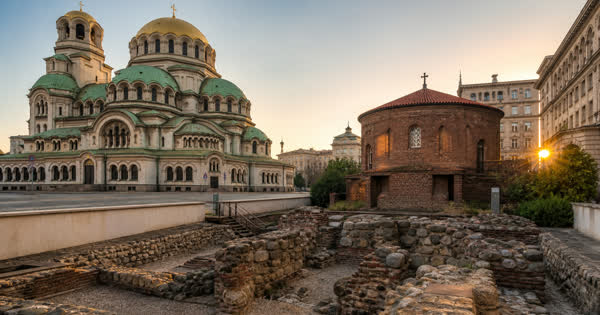
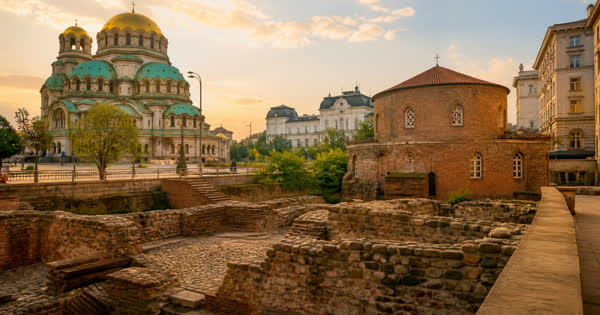
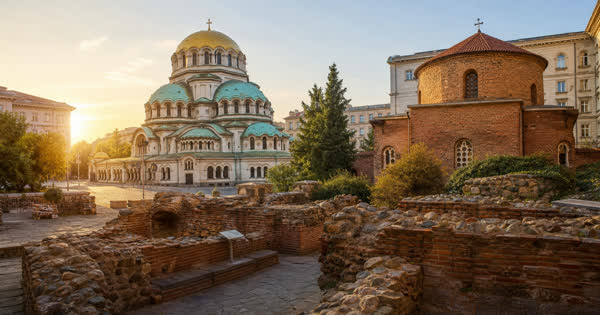
Standing before you is one of the largest Eastern Orthodox cathedrals in the world, built between 1882 and 1912 to honor the Russian soldiers who died liberating Bulgaria from Ottoman rule in the Russo-Turkish War of 1877–78. Designed by Russian architect Alexander Pomerantsev, it was dedicated to Saint Alexander Nevsky, the medieval Russian prince revered as a national hero. The cathedral can hold up to 10,000 worshippers beneath its glittering golden domes. Its construction became a symbol of Bulgarian independence and gratitude — a monumental thank-you carved in stone, gold, and mosaic that has watched over Sofia for over a century.
Plays on location, in the app
St. Nedelya Church
38s
Standing before you is St. Nedelya Church, one of Sofia's most storied landmarks — and the site of one of the deadliest assassinations attempts in European history. On April 16, 1925, communist militants detonated a massive bomb hidden in the roof, hoping to kill Tsar Boris III and his cabinet. The tsar survived, having arrived late, but over 150 people perished and hundreds were wounded. The church, originally built in the 10th century and rebuilt multiple times, was devastated yet again restored. Its walls silently carry centuries of Bulgarian faith, resilience, and turbulent political drama.
Plays on location, in the app
Serdika Metro Station
50s
The Alexander Nevsky Cathedral with its golden dome dominates a square where a 5th-century early Christian basilica, a 15th-century Ottoman mosque, and a 19th-century neoclassical palace all stand simultaneously. This layering is not disorder, it is the visual synthesis of 3,000 years of uninterrupted history. Descending into Serdica Metro Station, inaugurated in 1998, passengers waiting for the train look through glass panels at the Roman ruins of Serdica, from the 2nd to 4th-century AD walls, towers, streets, lit up and visible from the platform. It is one of the few cases in the world where a modern metro station was designed around an archaeological site, integrating it as a permanent architectural element. It is not a museum, it is the daily train station of Sofia residents, with 2,000 years of history visible through the glass.
Plays on location, in the app
The full story plays on location, in the appLocation-based audio on Voxter