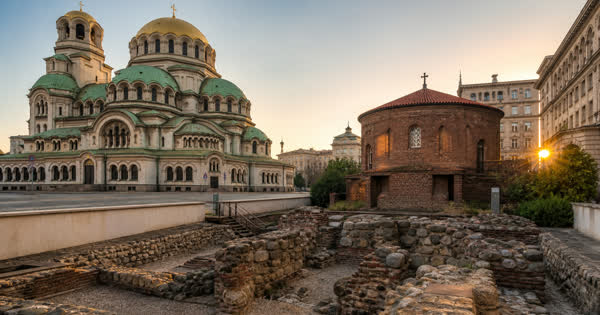
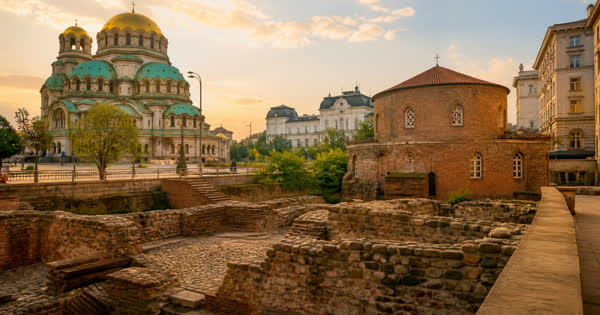
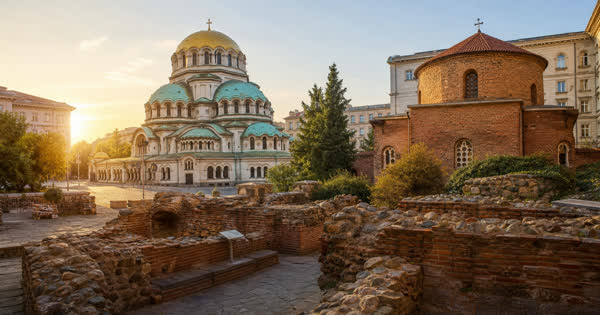
Look down at those famous yellow cobblestones — then look deeper. Under the square, glass domes installed in 2006 replaced a lawn and flagpoles, revealing the ruins of Serdica below your feet. Two underpasses run down here, and one of them shelters a medieval church, Saint Petka, linked to the metro. Now the secret above. The Party House once wore a red star, and in August 1990 fire tore through it for hours, destroying forty rooms and piles of documents. One account blames a man protesting that the star was still up there. Interior Ministry archives kept inside simply vanished. The star came down by helicopter, and the Bulgarian flag took its place. One more ghost: a sixteen-storey Palace of the Soviets was planned here, never built.
Plays on location, in the app
Knyaz Aleksandar Dondukov Boulevard
1:02
Here's a secret hiding under your feet. Before the Liberation of Bulgaria, this grand boulevard was nothing but a narrow, muddy little lane. Hard to believe, isn't it? In 1881 it was given the name it still carries, honouring the Russian general and statesman Alexander Dondukov-Korsakov. Locals just say "Dondukov". By 1901 one of the city's very first tram lines was rattling along here. Shops multiplied, and the street became a buzzing commercial artery. Then the world wars changed everything: the modest two-storey houses vanished, replaced by far bigger buildings. One survivor is the Adolf Funk house at number 59, built in 1904 and now home to the Bulgarian Red Cross. Another quiet twist: the former Party House now holds offices for members of parliament. Look around for the Presidency at number 2, and the Council of Ministers at number 1.
Plays on location, in the app
Ivan Vazov National Theatre
57s
Look up at that neoclassical facade — you're standing before Bulgaria's national theatre, the oldest in the country. It was founded in 1904 by the actors of a troupe called Salza i Smyah. Their very first production was 'The Outcasts', written by Ivan Vazov himself. Two Viennese architects, Helmer and Fellner, drew up the building; it was finished in 1906 and opened on the third of January, 1907. Then disaster: in 1923, fire tore through the house during an anniversary celebration. German architect Martin Dulfer rebuilt it by 1929. A theatre school opened inside these walls in 1925. Wartime bombs struck again, and the theatre rose once more in 1945. For a decade, from 1952, it carried the name of Krastyu Sarafov.
Plays on location, in the app
Georgi Rakovski Street
55s
You're walking along one of Sofia's great arteries, here in the heart of Bulgaria's capital. Older residents may still call it Rakovska, its former name. The street honours Georgi Sava Rakovski, a Bulgarian revolutionary. It runs downtown, stretching between Boulevard Slivnitsa and Boulevard Evlogi Georgiev. Along the way you'll pass the Aleksandar Nevski Cathedral and the Central Military Club. Now, the stretch from Slavejkov Square to Boulevard Dondukov packs in theatre after theatre. That's why locals nicknamed it the Street of Theatres, or the Bulgarian Broadway. Look for the Ivan Vazov National Theatre and Theatre 199. The Bulgarian Army Theatre and the National Opera face this street too. Then there's the Aleko Konstantinov Satirical Theatre and the Puppet Theatre. Ministries stand close by, including Economy and Finance.
Plays on location, in the app
Georgi Dimitrov Mausoleum
1:29
Look around Battenberg Square: a white marble mausoleum once stood right here. It went up in 1949, built to hold the embalmed body of Georgi Dimitrov. Workers raised it in just six days, exactly the time the coffin needed to travel from the USSR. Vasil Kolarov was later laid in a niche in the east wall. This was the stage for state ceremonies, with foreign delegations laying wreaths. Guards of the National Guard stood at "Post No. 1" on Sundays, Wednesdays and solemn days, rifles empty, without cartridges. In 1956 fourteen anti-communists plotted to blow it up on May Day, with timed bombs set for the moment party leaders took the podium. Stoyan Zarev also wanted five ministries destroyed, to pull the world's media towards Bulgaria. The secret police caught them in February 1960. A crystal sarcophagus and mosaics by Dechko Uzunov arrived in 1974-75. In 1990 Dimitrov's body was cremated and buried in Sofia's Central Cemetery. Ivan Kostov's government demolished the building in 1999, though two thirds of Bulgarians opposed it and some wanted a museum instead. It took four attempts: three failed, leaving it only slightly tilted, until smaller blasts finally brought it down.
Plays on location, in the app
National Art Gallery
54s
Look up: this was once the Royal Palace, inaugurated on the 26th of December, 1882. It rose on the site of an Ottoman mosque and a konak. Under Ferdinand the First, Friedrich Grünanger added the neo-Baroque east wing. Inside were the royal apartments, and even an elevator. The country's first art department had started back in 1892, inside the Archaeological Museum. Its paintings survived the bombings of 1943 and 1944. One earlier home, designed by Bulgaria's first woman architect, was destroyed by a bomb. After the monarchy was abolished, the gallery moved into the palace in 1946. A decree of the 24th of November, 1948 made it official. Since 2015 it is simply the National Gallery.
Plays on location, in the app
City Garden
1:21
You're standing in Sofia's oldest public garden, alive since 1872. It sits right in the historic core, between Boulevard Tsar Osvoboditel and the streets Knyaz Alexander Battenberg and Gourko. It was laid out in the final years of Ottoman rule. After the Liberation of 1878, governor Pyotr Alabin pushed for a rethink, and city architect Antonín Kolář redrew it completely. In came fresh alleys, new plantings, a wooden fence, a café, and a little pavilion for musicians. Its first name honoured the Russian tsar: the Alexander the Second Garden. Gardeners like Karl Betz, Daniel Neff and Iliya Todorov shaped every corner. Under communism, the Georgi Dimitrov Mausoleum rose here, now gone. Redesigns in 1951, 1959, 1976 and 1978 turned the garden away from the former royal palace, towards the Ivan Vazov National Theatre, and cost it land and key architectural features. On 27 August 1895, some three hundred people gathered here with Aleko Konstantinov to climb Cherni vrah, the birthday of Bulgarian tourism. Today, amateur chess players hold court in front of the theatre.
Plays on location, in the app
Church of St. Nicholas, Sofia
49s
Look down Kaloyan Street, just behind the Hotel Rila — that small church is St. Nicholas. It's an Eastern Orthodox church here in Sofia, Bulgaria's capital, and it belongs to the Bulgarian Orthodox Church. Its story starts in the thirteenth century, when the sebastokrator Kaloyan raised it as a modest chapel for his own family. But go deeper, and the ground has an older tale. The church is said to stand over a Roman palace complex that once hosted Constantine the Great. Those Roman walls survive underground, still visible beneath the temple. Even today, hundreds of Sofia's residents come each year to receive the blessing of the saints. And every December the sixth, the chapel celebrates its patron feast.
Plays on location, in the app
Church of St Paraskeva
51s
Look up: you're standing beside a Bulgarian Orthodox church right in the heart of Sofia. The address is 58 Georgi Rakovski Street, and this is the third largest church in the city. Its story begins in 1910, when architect Anton Tornyov won the design competition. Then history intervened: the Balkan wars and the First World War pushed the building work back by years. A second competition was held in 1922, and Tornyov won all over again. Construction wrapped up in 1930, though the porticoes waited until 1940. Notice how unusual it looks for an Eastern Orthodox church. Inside, the cella is a round chamber more than twenty metres across, melting gently into the apses around it.
Plays on location, in the app
Church of the Seven Saints
1:05
Look up: this is the Church of the Seven Saints, honouring the seven saints of the Bulgarian Orthodox Church, and a true emblem of Sofia. You're on Graf Ignatiev Street, a short stroll from the Aleksandr Nevskij cathedral, with the Sv. Patriarch Evtimiy metro stop on line M3 right nearby. Here's the twist: it began life in 1528 as a mosque, ordered by Suleiman the Magnificent. People called it the black mosque, and it was dedicated to Sokollu Mehmed Pasha, whose friend Michail Kantakouzenos was hanged. It stood for Ottoman power in the Eyalet of Rumelia, at a time when Sofia had never been a capital of the Bulgarian lands. Long before, a sanctuary of Asclepius stood here, then a convent of the Rila Monastery. After Bulgaria's liberation, the mosque became a church. In the courtyard rest Petko Karavelov, his wife, and Bishop Neil Izvorov. And just in front, General Konstantin Georgiev was killed; his funeral became the scene of the Sveta Nedelja attack.
Plays on location, in the app
The full story plays on location, in the appLocation-based audio on Voxter