Zagreb is home to one of the most unusual museums in the world, the Museum of Broken Relationships, housed in the Baroque Kulma Palace in the Uppertown. Founded in 2006 by Croatian artists Olinka Vistica and Drazen Grubesic, after the end of their own relationship, it began as a touring exhibition, before finding its permanent home in Zagreb in 2010. The collection consists entirely of objects donated by people from around the world, each accompanied by a short text describing the relationship, and the story behind the object. Donations have arrived from over 60 countries. There are no famous artworks and no historical artefacts. Only personal objects. A garden gnome, a pair of shoes, an axe, a wedding dress. The museum won the Council of Europe Museum Prize in 2011. It has since opened a second permanent location in Los Angeles. It is consistently rated one of the top attractions in Zagreb, and one of the most emotionally affecting museums in Europe.
Plays on location, in the app
Dolac Market
51s
Dolak Market, above Banja Lasik Square, buzzes with fresh produce, flowers and local goods, offering a colorful glimpse into Zagreb's daily life and culture. Dolak is the main open-air market of Zagreb, established in 1930, on a raised terrace just one minute's walk from Banja Lasik Square. The red parasols that cover the market stalls have become one of the iconic images of Zagreb. The indoor section below the open-air terrace sells meat, cheese and dairy products. The market is open every morning from Monday to Saturday, and in reduced form on Sundays. Arriving before 8am gives you the best choice and the least crowds. From the market terrace you look directly down onto Banja Lasik Square, one of the best views of the city centre from street level. The Dolak vendors are mostly small producers from the Zagreb region, and the surrounding Croatian countryside.
Plays on location, in the app
Tkalciceva Street
49s
Tikal Čečeva street is one of the nicest in the capital, with its pastel-coloured facades, bars and restaurants. This long, gently curving pedestrian street follows the former bed of the Medveskac stream, the natural border that for centuries separated the two rival medieval cities of Kaptol and Gradek. The stream was covered over in the 19th century, and the street built in its place. Krivovy Most bloody bridge, is a historic lane in Zagreb, named after medieval clashes between Gradek and Kaptol, now a peaceful spot with cafes and shops. The two communities fought repeatedly over this border, over rents, properties and jurisdiction, for centuries. The street that replaced their disputed boundary, is today the most lively and popular nightlife street in Zagreb. The history of a city's conflicts literally paved over, and turned into a place for eating and drinking.
Plays on location, in the app
Lotrscak Tower
46s
Since the 1st of January 1877, the Grick cannon fires daily from the Lottrischkack tower on Grick to mark midday. The Lottrischkack tower was built in the 13th century as part of the southern fortification of Gradec. It was used to ring a bell every evening to warn citizens that the city gates were about to close. Its name comes from the Latin latrunculorum, the bell of the thieves, because after the bell rang, anyone still outside the walls was assumed to be a thief. Today the cannon fired from its top at noon, is one of Zagreb's most reliable daily rituals, audible across the entire upper and lower town. Climbing the tower offers a panoramic view over the red rooftops of the upper town and, on clear days, the snow-capped peaks of Medvednica mountain directly above the city.
Plays on location, in the app
Stone Gate
48s
The Stone Gate is the last remaining entrance to the medieval fortified city of Greideck. In 1731, a fire destroyed almost all the wooden buildings around the gate. According to local tradition, when the ruins were cleared, a painting of the Virgin Mary was found intact among the ashes, completely undamaged by the flames. The painting was interpreted as miraculous, and a chapel was built on the spot inside the gate arch. Today the Stone Gate is a permanent open-air shrine. Candles burn day and night, votive plaques cover the walls, and Zagrebers stop here to pray on their way through the city. It is one of the most intimate and unexpected sacred spaces in Central Europe. Not a grand church, but an arch in a medieval city wall, passed through by thousands of people every day, transformed by one fire in 1731 into a place of pilgrimage.
Plays on location, in the app
St Mark's Church Zagreb
49s
The first place not to be missed in Zagreb's upper town is St. Mark's Square, with its 13th-century church. The church has a typical bulbous bell tower and a roof with coloured tiles representing the city's crest, and a symbol of the unification of the kingdoms of Croatia, Dalmatia and Slavonia. The tiled roof, restored in 1880, displays two coats of arms in a mosaic of coloured glazed tiles. On the left the combined arms of the kingdom of Croatia, Dalmatia and Slavonia. On the right, the emblem of Zagreb itself. It has become the most photographed image of the city. The church stands in the heart of the upper town, flanked by the Croatian Parliament and the Government Building, a medieval church between the two seats of the modern state. St. Mark's Square is the political heart of Croatia. Laws are passed in buildings that have looked at this church's tiled roof for centuries.
Plays on location, in the app
Ban Jelacic Square
1:01
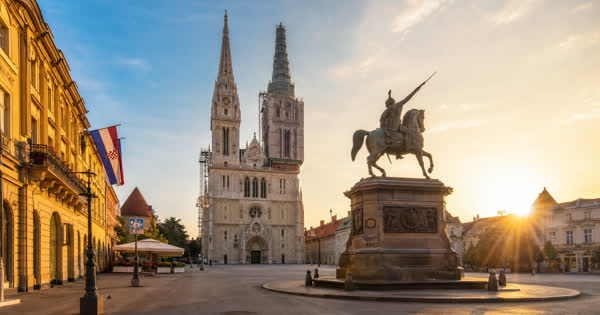
A common narrative in Croatia suggests that the statue of Ban Jelacik, before its removal by communist authorities in 1947, faced north, symbolically pointing towards Hungary due to historical conflicts. However, the original orientation, as intended by the sculptor Fernkorn, was towards the most populated area of the city at that time, the upper town. Consequently, the statue currently faces south. The statue features the Ban riding his white horse Emir, a gift from Mahmud Beg Basic of Bihac. Jelacic rode Emir during his enthronement in Zagreb in 1848. Emir died ten years after the Ban, and served as the model for Fernkorn's 1866 sculpture. The sabre held by Ban Jelacik bears an Arabic inscription, a gift from Omer Pashalatas. The inscription reads, I have relied on Allah, and, There is no hero but Ali, and no sword but Dhulfiqar. A Croatian national hero carries an Ottoman sabre with an Islamic inscription, in the centre of the Croatian capital's main square, for over 150 years.
Plays on location, in the app
Ban Jelacic Square
58s
Ban Jelačić Square is the central square of the city of Zagreb. Its official name is Trg bana Josipa Jelačica and is colloquially called Jelačić Plak. In 1848, the square was renamed Ban Jelačić Square in honor of Josip Jelačić. Its modern identity was further established on 19 October 1866, when a monumental equestrian statue of Jelačić, created by Austrian sculptor Anton Dominic Fernkorn, was erected. The square was the site of the welcome extended to the Ustasa regime in 1941, and the entry of partisan forces into Zagreb in 1945. The following year, Jelačić's statue was removed, after the communist authorities denounced him as a quote, servant of foreign interests. The monument was preserved in the cellar of the Gliptoteca gallery by its curator, Anton Bauer. With the independence of the Republic of Croatia in 1990, both the statue and the historic name Ban Jelačić Square were restored.
Plays on location, in the app
Zagreb Cathedral
52s
The Zagreb Cathedral already had an organ in the 15th century. Today's large organ has four manuals, 78 registers, and 6068 pipes, built by Vorka from Ludwigsburg. It is classified among the top ten finest and top quality organs in the world. Inside the soaring interior is adorned with stained glass windows, ornate altars, and the tomb of Cardinal Aloysius Stepanak, a highly revered figure in Croatian history. In the stone recesses of the apse, there are stone tablets with a list of all Zagreb bishops and archbishops, 67 bishops and 7 archbishops, five of whom were cardinals. The cathedral's twin neo-Gothic spires, completed after the 1880 earthquake, rise to 108 metres, and can be seen from almost anywhere in Zagreb. They are the city's primary landmark, visible across the entire metropolitan area.
Plays on location, in the app
Zagreb Cathedral
1:04
The Zagreb Cathedral is the tallest sacral building in Croatia, and the most monumental sacral building of Gothic architecture southeast of the Alps. The original cathedral was completed in 1217 in Romanesque style, but it was heavily damaged during the Tatar invasion of 1242. The cathedral's origins date back to the 11th century, though it has been rebuilt several times due to invasions and natural disasters, most notably after the Mongol attack in the 13th century, and the devastating earthquake of 1880, when it was reconstructed in the Neo-Gothic style that defines its present form. The first recorded appearance of the name Zagreb dates from 1094, at which time the city existed as two different city centres. The smaller, eastern capital, inhabited mainly by clergy and housing Zagreb Cathedral, and the larger, western gredek, inhabited mainly by craftsmen and merchants. In 2020, a magnitude 5.5 earthquake struck Zagreb. The cathedral lost the cross of one of its twin spires. It is currently undergoing extensive restoration.
Plays on location, in the app
The full story plays on location, in the appLocation-based audio on Voxter