The Greben is one of the oldest and most elegant pedestrian streets in Vienna. Its name means ditch, because in Roman times it was the defensive moat of the Roman castrum of Vindabona. At the centre of the Greben stands the plague column, the Pestsau, erected in 1693 by Emperor Leopold I, to give thanks to God for the end of the great plague epidemic of 1679, which had killed around one third of Vienna's population. The Baroque sculpture stands 21 metres tall and depicts the Emperor kneeling before the Holy Trinity, with the figure of faith vanquishing the plague. It was designed by Johann Bernhard Fischer von Erlach, the same architect who would later design the Karlskirche. The Greben surrounding the column is still today one of the most frequented promenades in Vienna, just as it was in the 17th century when the column was inaugurated.
Plays on location, in the app
Belvedere Museum
49s
The Belvedere Palace was built as a summer residence for Prince Eugene of Savoy, the general who saved Vienna from the Ottoman siege of 1683 and became the most powerful and wealthy man in the empire. The Baroque Palace was built on a hill, at the time still outside the city, and for this reason bears the name Belvedere – Beautiful View. Only in Vienna can you admire the world's largest collection of Bruegel, and the most celebrated kiss in the history of art, created by the painter, Gustav Klimt. The kiss was exhibited for the first time in 1908, and immediately purchased by Emperor Franz Joseph, one of the rare occasions on which the sovereign showed enthusiasm for modern art. The painting has never left Vienna. It hangs on the first floor of the Upper Belvedere, in the same room where in 1955 the state treaty was signed, restoring Austria's sovereignty after the Allied occupation.
Plays on location, in the app
Vienna State Opera
49s
The Vienna Opera was inaugurated in 1869, the first major building completed on the new Ringstrasse. Its debut was a disaster. Viennese newspapers harshly attacked the design by architects August Sikard von Sikardsberg and Eduard van der Null, calling it a sunken shoebox. Van der Null took his own life two months before the opening night. Sikardsberg died of a broken heart six weeks later. Emperor Franz Josef, deeply affected by the tragedy, decided never again to express public opinions on art or architecture, replying to anyone who asked his view with simply, it was very beautiful, I liked it very much. The Vienna State Opera is today one of the most important opera houses in the world, with around 300 performances a year, and a repertoire of 60 different operas per season. Aas
Plays on location, in the app
Loos House
49s
Over a hundred years ago, Vienna was the scene of an architectural scandal. The pioneer of Viennese modernism, Adolf Loos, built a revolutionary building directly opposite the imperial Hofburg, the Loos House. Its facade, devoid of the ornate decorations typical of the era, outraged Emperor Franz Joseph I, who reportedly called it, a house without eyebrows. The building was completed in 1911, five years after construction began, and following years of controversy and work stoppages. In 1908 Loos had published the essay, Ornament and Crime, arguing that decorating objects was a crime against civilization. The Loos House on Michaelerplatz, was his practical response to the Baroque imperial aesthetic surrounding it. Franz Joseph it is said, never again opened the windows of his apartments that looked out onto the building's facade.
Plays on location, in the app
Mozart's House
47s
Between 1784 and 1787, Mozart lived with his family in an apartment at Dom Gas V. It is the only one of the composer's Viennese residences to have survived intact. In this apartment Mozart composed The Marriage of Figaro in 1786, one of the most revolutionary operas in the history of music, which received its world premiere at the Burgtheater on 1 May 1786. Lorenzo da Ponte wrote the libretto here. Emperor Joseph II, though an admirer of Mozart, had initially banned the production because it was based on Beaumarchais' comedy, which was then forbidden for its revolutionary, anti-aristocratic implications. He relented after reading the libretto. Three years later the Bastille fell. The apartment is today the Mose of the Arche Vienna, a museum open to the public.
Plays on location, in the app
Schönbrunn Palace
51s
Empress Maria Theresa, who ruled for 40 years, moved the imperial residence to Schönbrunn Palace, which she had built on the outskirts of Vienna, helping to make the city a leading artistic capital by promoting music. It was during her reign that the star of Wolfgang Amadeus Mozart began to shine. The palace, declared a UNESCO World Heritage Site, boasts 1,441 rooms, many of which are open to the public. Schönbrunn Zoo, in the palace gardens, is the oldest zoo in the world, founded in 1752. In 1762, at the age of six, Mozart performed for Empress Maria Theresa in the palace. According to legend he slipped on the polished floor and fell in front of the empress, who helped him to his feet. Mozart then reportedly asked to marry the young princess Marie Antoinette his contemporary, her reply is not documented.
Plays on location, in the app
Imperial Crypt of the Capuchins
49s
Located beneath the Capuchin Church, very close to the Hofburg, the imperial crypt of Vienna houses more than 140 remains. Emperors, princesses, duchesses, kings and archdukes find their eternal rest in this burial site, the Habsburgs' preferred resting place since the 17th century. Among the most famous tombs are those of Empress Elizabeth, Cissi, her husband Emperor Franz Joseph I, and Archduke Rudolf. The Habsburg funeral protocol required that the emperor's body be divided into three parts, the body here, the heart at the Augustiner Kirche in a dedicated silver urn, and the viscera in the catacombs of the Stephansdom. This practice, known as tripartite burial, was followed uninterrupted by the Habsburgs for over two centuries, until Emperor Franz Joseph in 1916.
Plays on location, in the app
Hofburg Palace — Heldenplatz
52s
The Hofburg covers 240,000 square meters and comprises 18 wings, 19 courtyards and two 600 rooms, in which around 5,000 people still live and work today. For over 600 years the Hofburg was the residence of the Habsburg dynasty and became one of the focal points of European history. It was from this palace that the Habsburgs ruled from the 13th century onwards, first as sovereigns of Austria, from 1452 as elected emperors of the Holy Roman Empire, and finally after 1806 as emperors of Austria until the end of the monarchy in 1918. On 15 March 1938, Adolf Hitler proclaimed the annexation of Austria to the Third Reich, from the balcony of the Neuer Burg overlooking Heldenplatz, the same balcony from which emperors had greeted Viennese crowds for centuries. The square that evening was packed with 200,000 people.
Plays on location, in the app
St. Stephen's Cathedral — Stephansplatz 3
49s
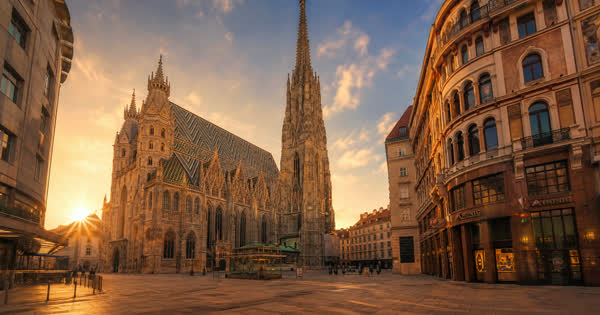
St. Stephen's Cathedral dates back to 1137, though it was expanded and restored over the centuries, being richly enriched with Romanesque, Gothic and Renaissance elements. Both the wedding and the funeral of Mozart were held here. It has been a cathedral church since 1365, a bishop's seat since 1469-1479, and the Metropolitan Church of the Archbishop of Vienna since 1723. The roof is covered with 230,000 glazed ceramic tiles arranged to form the double imperial Habsburg coat of arms, visible from above and from the surrounding rooftops. The catacombs beneath the cathedral hold the urns containing the viscera of the Habsburg emperors. The body was buried in the imperial crypt of the Kaposi, the heart in the Herzgrift at the Augustinikirche, the internal organs here. Three locations for a single emperor.
Plays on location, in the app
The full story plays on location, in the appLocation-based audio on Voxter