← All places in Sofia Secret Sofia: Curiosities in the City's Heart

Secret Sofia: Curiosities in the City's Heart

6 stops 35 min Sofia

Uncover Sofia's hidden side: from the secrets of the Largo to ancient metro ruins, up to the wonders of the Nevsky Crypt. A surprise-filled walk through the beating heart of the Bulgarian capital.

The stops

1

Largo

52s

Look down at those famous yellow cobblestones — then look deeper. Under the square, glass domes installed in 2006 replaced a lawn and flagpoles, revealing the ruins of Serdica below your feet. Two underpasses run down here, and one of them shelters a medieval church, Saint Petka, linked to the metro. Now the secret above. The Party House once wore a red star, and in August 1990 fire tore through it for hours, destroying forty rooms and piles of documents. One account blames a man protesting that the star was still up there. Interior Ministry archives kept inside simply vanished. The star came down by helicopter, and the Bulgarian flag took its place. One more ghost: a sixteen-storey Palace of the Soviets was planned here, never built.

Plays on location, in the app
2

Serdika Metro Station

50s

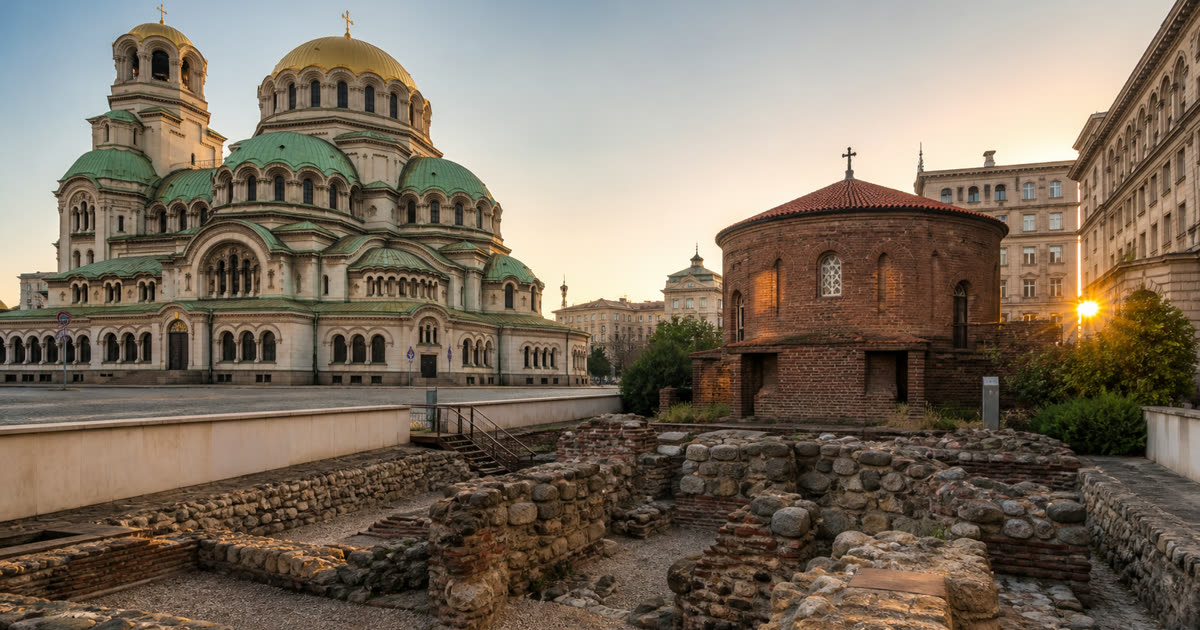
The Alexander Nevsky Cathedral with its golden dome dominates a square where a 5th-century early Christian basilica, a 15th-century Ottoman mosque, and a 19th-century neoclassical palace all stand simultaneously. This layering is not disorder, it is the visual synthesis of 3,000 years of uninterrupted history. Descending into Serdica Metro Station, inaugurated in 1998, passengers waiting for the train look through glass panels at the Roman ruins of Serdica, from the 2nd to 4th-century AD walls, towers, streets, lit up and visible from the platform. It is one of the few cases in the world where a modern metro station was designed around an archaeological site, integrating it as a permanent architectural element. It is not a museum, it is the daily train station of Sofia residents, with 2,000 years of history visible through the glass.

Plays on location, in the app
3

Central Sofia Market Hall

1:08

Look up: you're standing beside Sofia's Central Market Hall, on Boulevard Marie Louise. Locals just call it the Halite. Back in 1907, the city picked a design by architect Naum Torbov, and building took two years. The doors opened in 1911, and it still trades today. Spread over 3,200 square metres, it's widely called Torbov's finest work, done in neo-Renaissance style. Above the main entrance, spot the relief of Sofia's coat of arms by Haralampi Tachev. A small clock tower with three faces crowns the roof. Four entrances were built originally; not all are in use now. Until the late 1940s the municipality rented out around 170 shops and stalls, with rents and product quality tightly controlled. It closed in 1988 for rebuilding and reopened at Easter 2000. The Israeli company Ashtrom took 75% and invested seven million dollars. Inside today: a supermarket and just a handful of shops.

Plays on location, in the app
4

Maria Luiza Boulevard

58s

Keep walking, and lean in for a moment. This central Sofia boulevard hides a small secret in its name. Today it honours Maria Luisa of Bourbon-Parma, wife of Ferdinand the First. But under communism, the very same street carried the name of Georgi Dimitrov. One road, two identities. Follow it and you cross the Lavov Most, the Bridge of the Lions, one of the city's most emblematic crossings. Along the way, watch for the Covered Market, the church of Sveta Nedelya, and the Public Baths. Below your feet runs the new metro station named after the same princess. And just off to the side, a square paved in yellow: Prince Alexander of Battenberg. Nearby stand the Presidency, the Council of Ministers and the deputies' offices, together forming the Largo. The street runs from the Central Station to Vitosha Boulevard, which carries on to the National Palace of Culture.

Plays on location, in the app
5

National Archaeological Museum

52s

Sofia has been the capital of Thrace, a Roman city named Serdica, so beloved by Emperor Constantine the Great that he considered making it the seat of the Empire instead of Byzantium, then a medieval Bulgarian settlement, and finally an Ottoman capital of the Balkans for almost five centuries. The National Archaeological Museum is housed in the former 15th-century Ottoman Grand Mosque, the Boyuk Kamei, built by the Turks after their conquest of the city in 1382. It was the first mosque built in Sofia after the Ottoman conquest, following Bulgarian liberation in 1878, it was converted into a museum. The Ottoman building now houses the most important collection of Bulgarian antiquities, Thracian, Roman, medieval and proto-Bulgarian artefacts. Among the most extraordinary pieces are the Thracian gold treasures, some of the oldest and finest goldwork of the ancient world.

Plays on location, in the app
6

Alexander Nevsky Cathedral Crypt

48s

The Crypt of the Cathedral, originally designed to house the tombs of Bulgarian sovereigns, is home to a museum of icons from across Bulgaria, and forms part of the National Gallery. It is the largest collection of Bulgarian icons in Europe. The exhibition displays over 200 icons dating from the 13th to the 19th century, three fragments of mural paintings, engravings, and other ancient religious artefacts. The oldest date back to the 13th century, among them, the Madonna of Hodeghetria, the only Bulgarian mosaic icon. From the following century, come the icons of Saint Michael and Saint Gabriel, from the Bakavo Monastery. The crypt is open separately from the church, Tuesday to Sunday, and is one of the most important museums of medieval religious art in the Balkans, almost unknown to Western tourism.

Plays on location, in the app
The full story plays on location, in the appLocation-based audio on Voxter
Get Voxter