← All places in Sofia Ancient Sofia: Heart of History and Culture

Ancient Sofia: Heart of History and Culture

7 stops 45 min Sofia

A journey through time among Sofia's most significant landmarks: from ancient Roman rotundas to medieval churches, historic markets and art museums. A compact route to discover the millennial soul of the Bulgarian capital.

The stops

1

Central Sofia Market Hall

1:08

Look up: you're standing beside Sofia's Central Market Hall, on Boulevard Marie Louise. Locals just call it the Halite. Back in 1907, the city picked a design by architect Naum Torbov, and building took two years. The doors opened in 1911, and it still trades today. Spread over 3,200 square metres, it's widely called Torbov's finest work, done in neo-Renaissance style. Above the main entrance, spot the relief of Sofia's coat of arms by Haralampi Tachev. A small clock tower with three faces crowns the roof. Four entrances were built originally; not all are in use now. Until the late 1940s the municipality rented out around 170 shops and stalls, with rents and product quality tightly controlled. It closed in 1988 for rebuilding and reopened at Easter 2000. The Israeli company Ashtrom took 75% and invested seven million dollars. Inside today: a supermarket and just a handful of shops.

Plays on location, in the app
2

Maria Luiza Boulevard

58s

Keep walking, and lean in for a moment. This central Sofia boulevard hides a small secret in its name. Today it honours Maria Luisa of Bourbon-Parma, wife of Ferdinand the First. But under communism, the very same street carried the name of Georgi Dimitrov. One road, two identities. Follow it and you cross the Lavov Most, the Bridge of the Lions, one of the city's most emblematic crossings. Along the way, watch for the Covered Market, the church of Sveta Nedelya, and the Public Baths. Below your feet runs the new metro station named after the same princess. And just off to the side, a square paved in yellow: Prince Alexander of Battenberg. Nearby stand the Presidency, the Council of Ministers and the deputies' offices, together forming the Largo. The street runs from the Central Station to Vitosha Boulevard, which carries on to the National Palace of Culture.

Plays on location, in the app
3

Rotunda of Saint George

50s

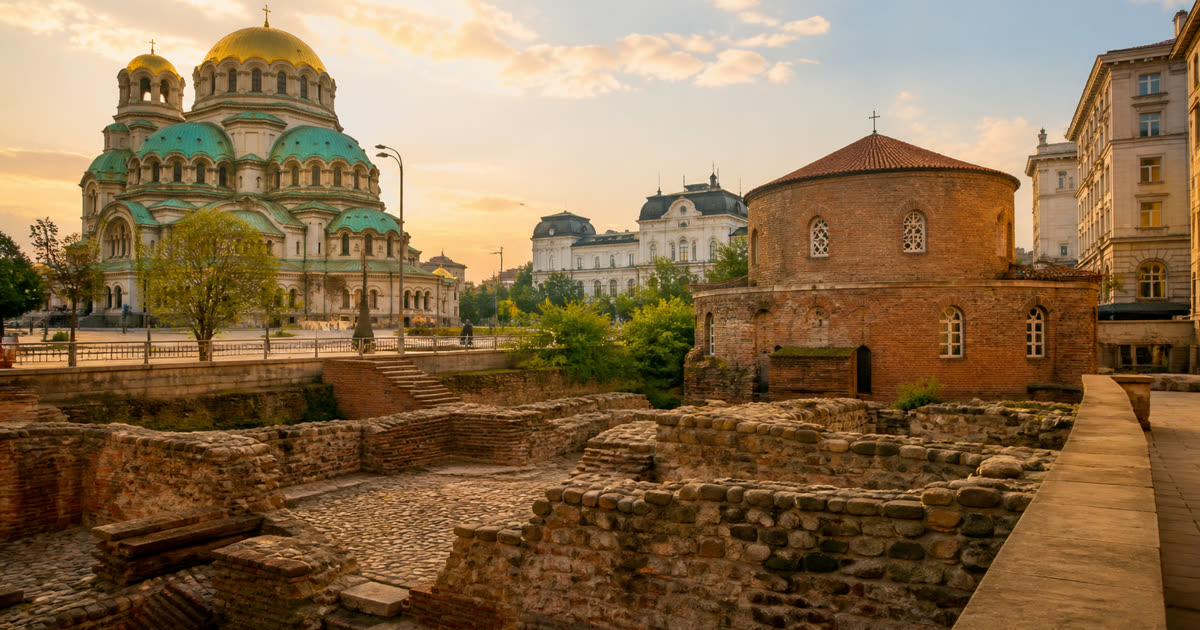
The Church of St. George is a circular early Christian church built at Serdica, the ancient name of Sophia. Built in red brick, it is considered the oldest building in the Bulgarian capital. The structure was erected by the Romans in the 4th century as a cylindrical domed building on a square base. Built as part of the imperial thermal complex of Roman Serdica, the city that Emperor Constantine I loved to call My Rome, the Rotunda is a circular red brick building 10 meters in diameter, topped by a dome that rises 14 meters. It is famous for its interior frescoes from the 12th, 13th and 14th centuries, of which three layers have been discovered so far. The church stands in the courtyard between the Balkan Hotel Sophia and the seat of the President of Bulgaria. The ground level of the church and the surrounding ruins is several meters lower than the current street level of Sophia.

Plays on location, in the app
4

Rotunda of Saint George

37s

During the Ottoman occupation in the 16th century, the church was converted into a mosque. The frescoes on the dome were destroyed during the Ottoman rule. They were only discovered and restored in the 20th century. From 1895 until his burial in his own mausoleum in 1897, it served as the resting place of Alexander of Battenberg, the first prince of modern Bulgaria. The rotunda is literally hidden in the courtyard of a modern building, it cannot be seen from the street. You need to enter the courtyard of the Presidency of the Republic to find it. It is one of the best preserved Roman monuments in the Balkans, and very few tourists ever find it.

Plays on location, in the app
5

Church of St. Nicholas, Sofia

49s

Look down Kaloyan Street, just behind the Hotel Rila — that small church is St. Nicholas. It's an Eastern Orthodox church here in Sofia, Bulgaria's capital, and it belongs to the Bulgarian Orthodox Church. Its story starts in the thirteenth century, when the sebastokrator Kaloyan raised it as a modest chapel for his own family. But go deeper, and the ground has an older tale. The church is said to stand over a Roman palace complex that once hosted Constantine the Great. Those Roman walls survive underground, still visible beneath the temple. Even today, hundreds of Sofia's residents come each year to receive the blessing of the saints. And every December the sixth, the chapel celebrates its patron feast.

Plays on location, in the app
6

National Art Gallery

54s

Look up: this was once the Royal Palace, inaugurated on the 26th of December, 1882. It rose on the site of an Ottoman mosque and a konak. Under Ferdinand the First, Friedrich Grünanger added the neo-Baroque east wing. Inside were the royal apartments, and even an elevator. The country's first art department had started back in 1892, inside the Archaeological Museum. Its paintings survived the bombings of 1943 and 1944. One earlier home, designed by Bulgaria's first woman architect, was destroyed by a bomb. After the monarchy was abolished, the gallery moved into the palace in 1946. A decree of the 24th of November, 1948 made it official. Since 2015 it is simply the National Gallery.

Plays on location, in the app
7

Georgi Dimitrov Mausoleum

1:29

Look around Battenberg Square: a white marble mausoleum once stood right here. It went up in 1949, built to hold the embalmed body of Georgi Dimitrov. Workers raised it in just six days, exactly the time the coffin needed to travel from the USSR. Vasil Kolarov was later laid in a niche in the east wall. This was the stage for state ceremonies, with foreign delegations laying wreaths. Guards of the National Guard stood at "Post No. 1" on Sundays, Wednesdays and solemn days, rifles empty, without cartridges. In 1956 fourteen anti-communists plotted to blow it up on May Day, with timed bombs set for the moment party leaders took the podium. Stoyan Zarev also wanted five ministries destroyed, to pull the world's media towards Bulgaria. The secret police caught them in February 1960. A crystal sarcophagus and mosaics by Dechko Uzunov arrived in 1974-75. In 1990 Dimitrov's body was cremated and buried in Sofia's Central Cemetery. Ivan Kostov's government demolished the building in 1999, though two thirds of Bulgarians opposed it and some wanted a museum instead. It took four attempts: three failed, leaving it only slightly tilted, until smaller blasts finally brought it down.

Plays on location, in the app
The full story plays on location, in the appLocation-based audio on Voxter
Get Voxter