Lagerwegur is Reykjavík's main shopping street, known for its boutiques, street art, and lively dining scene. The name means, hot spring road, it follows the path that Reykjavík's earliest residents walked to the geothermal hot springs at Lagerdalur to do their laundry, before piped hot water reached the city. The street runs from the city center eastward, and is the spine of Reykjavík's social life. The city's corrugated iron houses, painted in vivid colors and lining the streets off Lagerwegur, are one of Reykjavík's most distinctive visual features. The corrugated iron cladding was introduced in the late 19th century as a practical weatherproofing material, replacing the traditional turf houses. What began as a utilitarian solution, became an aesthetic identity. Walking Lagerwegur from end to end and turning into its side streets gives a more authentic sense of the city than any of its individual landmarks.
Plays on location, in the app
National Museum of Iceland
56s
The National Museum of Iceland, located at Suðugata 41, displays objects providing great insight into the nation's history and culture across 1-200 years. The museum was established on 24 February 1863. Its permanent exhibition, The Making of a Nation, is conceived as a journey through Iceland's history, starting with the ship that brought the island's first settlers in the 9th century, and ending with photographs of Keflavík Airport opening Iceland to the world. The museum houses over 2,000 objects, including Viking relics, medieval engravings and objects from Iceland's conversion to Christianity. One of the most significant pieces is a portable wooden door panel from the 11th century church at Valfjöfstadur, carved with a knight and a dragon, one of the finest examples of medieval woodcarving in Scandinavia. The museum also holds 6.5 million photographs, the largest collection of images in Iceland.
Plays on location, in the app
Sun Voyager Sculpture
51s
The Sun Voyager, Solfar in Icelandic, is a stainless-steel sculpture by artist Jón Gunnar Arneson that stands on the Reykjavik waterfront facing north across Faxefløy Bay. It was unveiled in 1990. The sculpture resembles a Viking longship, but Arneson insisted it was not intended as a Viking boat. It is a dreamboat, an ode to the sun, and a symbol of the promise of undiscovered territory, progress and freedom. Arneson died of leukaemia in 1989, a year before the sculpture was installed, and never saw it in its final position. As the Sun Voyager faces north, the clear skies behind offer one of the best places in the city to observe the northern lights on dark winter nights. It is free, always accessible, and best photographed at sunrise when the steel catches the early light and the mountains of the Snelfallsnæ Peninsula are visible across the bay.
Plays on location, in the app
Harpa Concert Hall
55s
Harper Concert Hall and Conference Centre is a masterpiece of contemporary architecture that dazzles with its geometric glass façade. Finished in 2011, the façade features an extraordinary patchwork of hundreds of glass panels designed in collaboration with Icelandic-Danish artist Ólafur Eliasson, inspired by the basalt column formations found across Iceland. Construction of Harper began in 2007, at the height of Iceland's financial boom. In October 2008, Iceland's banking system collapsed in what was proportionally the largest economic crisis ever suffered by any country in history relative to its size. Construction of Harper was almost abandoned mid-build. The government decided to complete it anyway, at public expense. Harper opened in 2011 and won the European Union Prize for Contemporary Architecture in 2013. It sits on the harbourfront, steps from the old fishing boats of the Old Harbour, a glass jewel at the edge of the North Atlantic.
Plays on location, in the app
Hofdi House
50s
Hof the Haus is a white wooden building on the Reykjavik waterfront that looks entirely unremarkable from the outside. It was built in 1909 as the French Consulate and later served as the British Embassy. On 11 and 12 October 1986, it became the site of one of the most significant summits of the 20th century, the meeting between US President Ronald Reagan and Soviet leader Mikhail Gorbachev, which laid the groundwork for the end of the Cold War. The two leaders came remarkably close to agreeing on the complete elimination of all nuclear weapons. The talks ultimately broke down over Reagan's refusal to abandon the strategic defence initiative. But the Reykjavik summit changed the trajectory of the Cold War and accelerated the arms reduction treaties that followed. The building is now used for municipal receptions. It is not open to the public inside but is free to approach from the waterfront path.
Plays on location, in the app
Settlement Exhibition Reykjavik Adalstraeti
49s
At Æthelstræti 10 in Reykjavík's city center, you can explore how the city developed from Iceland's settlement period. Æthelstræti is considered the oldest street in Reykjavík, located in the area of the original settlement. During construction work in 2001, excavations uncovered the remains of a Viking longhouse, dating from around 871 A.D., one of the oldest man-made structures ever found in Iceland. The longhouse was built by some of the first Norse settlers to arrive on the island, roughly coinciding with the date given in the Book of Settlements for Iceland's first permanent inhabitant, Ingólfur Arnarson. The exhibition was built around the ruins themselves, which remain in situ. You walk through a museum built directly over a Viking house that was occupied over 1, 100 years ago. Outside, Æthelstræti is the oldest continuously used street in Iceland.
Plays on location, in the app
Domkirkjan Cathedral
51s
Located in Østuvalur Square right next to the Parliament House, Domkirchen, the Reykjavik Cathedral, is modest in size, but has played a pivotal role in Iceland's religious and political history. Built in 1796, it is an excellent example of Icelandic neoclassical architecture, with clean lines and restrained design. It has been the site of numerous significant events, including the declaration of Iceland's independence from Denmark in 1944, celebrated here before the crowd moved to Þingvalir. The cathedral holds around 270 people. It is the seat of the Bishop of Iceland and the official church of the Icelandic state. Yet it is smaller than many parish churches in mainland Europe. Over 60% of Icelanders today identify as non-religious. The cathedral remains open, services are still held regularly, and entry is free.
Plays on location, in the app
Althingi Parliament House
52s
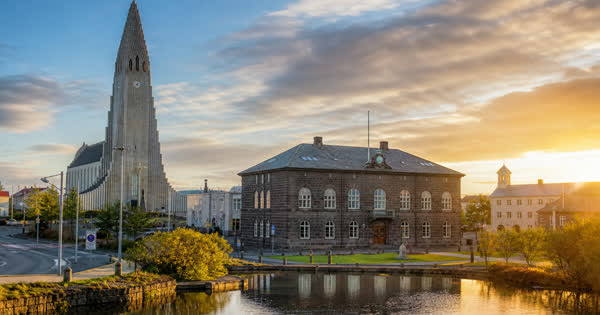
Parliament House, which stands on Østavola Square, was built in 1880-81. The Altingi Iceland's Parliament is one of the oldest parliamentary institutions in the world, having been established in 930 AD at Þingvellir, a site of volcanic plains 40 km east of Reykjavik. For over nine centuries it met in the open air at Þingvellir before moving to this modest stone building in the capital in 1881. The statue in Østavola Square beside the Parliament depicts Jón Sigurðarson, the leader of Iceland's independence movement against Danish rule. Iceland achieved full independence on 17 June 1944, a date chosen to coincide with Jón Sigurðarson's birthday. The current Parliament building is deliberately unpretentious, a small grey stone structure with no guards, no gates, no barriers. In Iceland the Parliament belongs to the people, it always has.
Plays on location, in the app
Hallgrimskirkja Tower
52s
A quick elevator ride takes you to the viewing platform at the top of Hallgrimskirkja, at 74.5 metres above the city. From here you get a 360-degree view over the entire capital, the colourful corrugated ironhouses, the harbour, Faxerfløy Bay, and on clear days the snow-capped outline of Mount Esther across the water. The interior of the church is deliberately minimalist and almost bare, a stark contrast to the dramatic exterior. The pipe organ inside has more than 5,000 pipes and weighs 25 tonnes. The tower is open to visitors every day, and the ticket costs a few euros. Go on a clear morning before the tour groups arrive, the light is at its best, and the city is quiet. Reykjavik is so compact that from this viewpoint you can see almost the entire urban area at once, a reminder that this is the world's northernmost capital, and one of its smallest.
Plays on location, in the app
Hallgrimskirkja
58s
Hallgrímskirkja is a 74.5 meter Lutheran church in central Reykjavik, and the most recognized landmark in Iceland. Designed by architect Gudjon Samuelsson, its towering facade resembles the hexagonal basalt columns found across Iceland's volcanic landscape. Construction started in 1945 and finished in 1986, it took 41 years to complete. It is the tallest church in Iceland, and the second tallest building in the country. The church is named after the 17th century clergyman and poet Hallgrímur Petarsson, author of the Passion Hymns, a cycle of 50 hymns that became one of the most read books in Icelandic history, and was recited aloud in homes across the country for centuries. Standing in front of the church is the statue of Leifur Íriksson, the Viking explorer believed to have reached North America five centuries before Columbus. The statue was a gift from the United States in 1930, to commemorate the thousand-year anniversary of Iceland's parliament.
Plays on location, in the app
The full story plays on location, in the appLocation-based audio on Voxter