← All places in Palermo Historic Walk in Palermo

Historic Walk in Palermo

5 stops 45 min Palermo

Explore Palermo's history through its iconic landmarks, from the Palazzo dei Normanni to the famous Via dei Beati Paoli.

The stops

1

Palazzo dei Normanni — Piazza del Parlamento

32s

The Palace of the Normans is the oldest royal residence in Europe still in use. It stands at the highest point of the city, where Carthaginians and Romans had already built their defenses. The Arabs built the castle called Qasr in the ninth century. The Normans transformed it into the royal palace of Roger the Second after 1130. Today it hosts the Sicilian Regional Assembly. In the same palace where the Sicilian Parliament meets, the remains of the original Arab structures are visible in the underground chambers.

Plays on location, in the app
2

Cappella Palatina — Palazzo dei Normanni

43s

The Palatine Chapel was commissioned by Roger II in 1132 and consecrated in 1140. It is a three-nave basilica in Siculo-Norman style declared a UNESCO heritage site in 2015. Its mosaics in Byzantine gold cover over 6,000 square meters of surface, among the most extensive medieval mosaic cycles in the world. They were created by Byzantine, Arab, and Norman craftsmen who worked side by side. The wooden stalactite ceiling is of Islamic craftsmanship, everything else is Christian. No other building in the world contains these three cultures simultaneously in such an integrated way.

Plays on location, in the app
3

Chiesa di San Giovanni degli Eremiti — Via dei Benedettini

42s

San Giovanni degli Eremiti was built at the behest of Roger II between 1130 and 1148, on the site of a Gregorian monastery founded in the 6th century. The five domes, which make it unmistakable, are of Islamic craftsmanship, built by Arab workers in the service of a Norman king for a Christian church. In 1882 the architect Giuseppe Patricolo, during a restoration, discovered traces of an ancient plaster that he interpreted as deep red and had the domes covered with that intense color. Before 1882 the domes were not red. Palermo's most iconic symbol has had that color for less than 150 years.

Plays on location, in the app
4

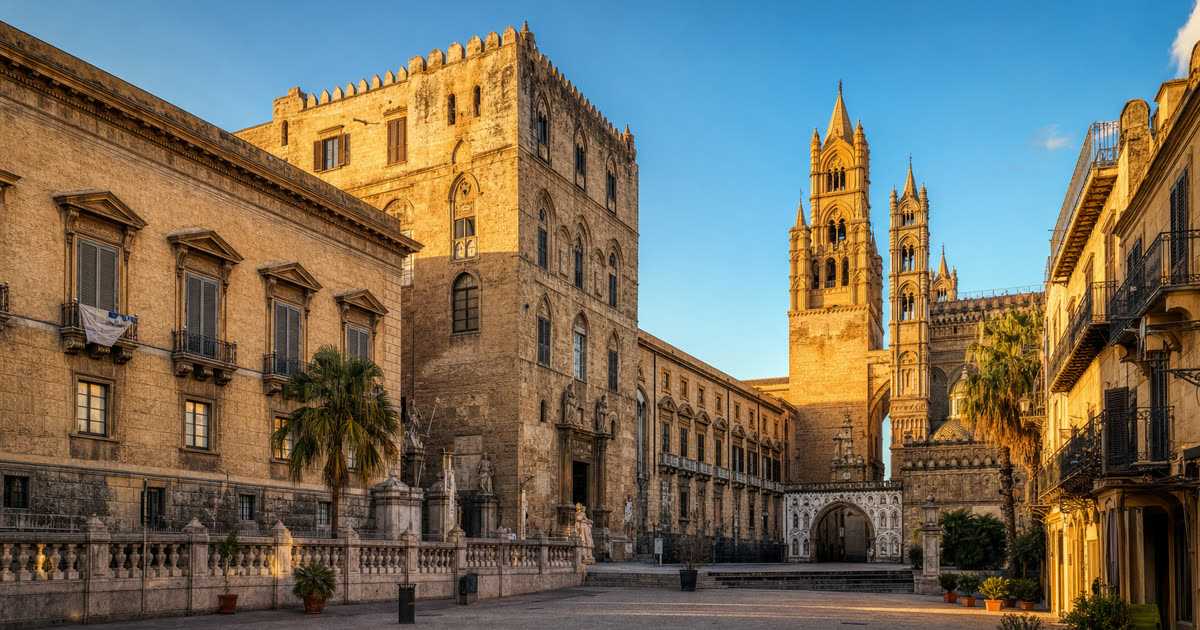
Cattedrale di Palermo — Corso Vittorio Emanuele

40s

The Cathedral of Palermo was built in 1184 at the behest of the Norman archbishop Walter Opard, on the same site where a 5th-century paleo-Christian church once stood, transformed into a mosque by the Arabs in the 9th century. The current structure is the result of over eight centuries of overlapping modifications, Gothic-Catalan, Aragonese, Baroque, and Neoclassical. The dome you see today was added by Ferdinando Fuga between 1781 and 1801. Inside are buried the Norman and Swabian kings of Sicily, including Frederick II of Swabia and Roger II.

Plays on location, in the app
5

Via dei Beati Paoli — Quartiere Capo

36s

Via dei Beati Paoli takes its name from a medieval Palermitan secret brotherhood, the Beati Paoli, who according to tradition would meet at night in the catacombs beneath the capo district to judge corrupt nobles and unjust powerful men. It is said that the condemned would be abducted at night and made to disappear without a trace. There is no certain historical evidence of their existence, but the novelist Luigi Natoli made them the protagonists of the most famous Sicilian historical novel, published in 1909. The street still bears their name, and the district has never forgotten them.

Plays on location, in the app
The full story plays on location, in the appLocation-based audio on Voxter
Get Voxter