Café Maiasmokk dates back to 1864. It is the oldest operating café in Estonia, known for its historic charm and elegant interior, which has remained unchanged for over a century. The café is also particularly famous for its delicious marzipan, and they have beautifully crafted figurines that make this café so iconic. Marzipan has been made in Tallinn since the 15th century. Some historians argue it was actually invented here rather than in Lübeck or Toledo, as competing traditions claim. The earliest documented recipe for Tallinn marzipan dates from 1695, in the city's pharmacy records. Today the craft marzipan workshops on the ground floor of Maiasmokk still shape the almond paste by hand into figures of animals, people and old town landmarks. The café's interior, dark wood, mirrors and brass fittings, has not changed since the 19th century. It is the right place to stop after walking the old town. Coffee, marzipan, and one of the oldest rooms in continuous use in the Baltic states.
Si ascolta sul posto, con l’app
Kohtuotsa Viewing Platform
47s
Tallinn's Old Town offers several fantastic viewpoints. Katowice gives sweeping views over the city's rooftops. The view from Toompea Hill to the Old Town is very beautiful. The Katowice viewing platform on Toompea Hill is the highest and most expansive of the Old Town's viewpoints, looking directly down over the red-tiled rooftops of the Lower Town, the medieval spires of St Olaf and the Town Hall, and beyond to Tallinn Bay and the Baltic Sea. The best times to visit are early morning before the tour groups arrive, or after dusk when the Old Town lights up and the crowds thin out completely. At night-time the whole place empties out and becomes incredibly atmospheric. From here, the medieval street plan of the Lower Town is perfectly visible from above. The same pattern of streets and blocks that has been unchanged since the 13th and 14th centuries.
Si ascolta sul posto, con l’app
Kiek in de Kok Tower
54s
Next to the Danish King's Garden is a large round artillery tower called Kiek in de Kock. Built in the late 15th century, this six-storey tower was another of the city's key defensive structures. On the outside you can see several cannonballs embedded in the tower which date from a battle in 1577. The name Kiek in de Kock means, peek into the kitchen in Low German, because the tower was so tall that guards at the top could see directly into the kitchens of the houses below. It was one of the most powerful artillery towers in northern Europe at the time of its construction, with walls up to four metres thick. The Hellermann Tower and Town Wall walkway features 1.85 kilometres of wall, 26 defence towers and two gates. The oldest sections of Tallinn's medieval walls date from the 13th century and are between three and five metres thick, among the most formidable urban fortifications surviving in the entire Baltic region.
Si ascolta sul posto, con l’app
Danish Kings Garden
55s
On the slopes of Toompea Hill, the Danish King's Garden is a pleasant landscaped garden enclosed by a section of the city walls and two towers. Named following the Danish invasion in 1219, the garden is a peaceful, slightly secluded corner of the old town. Legend has it that this is the birthplace of the Danish flag, the oldest continuously used national flag in the world. According to the legend, during the Battle of 1219 between the Danish Crusaders and the Estonian defenders, a red flag with a white cross fell from the sky, which the Danes interpreted as divine support and rallied to victory. That flag became the Dannebrog, the Danish national flag. Back in 1219, this is where the Danish King Valdemar II camped with his troops, before conquering Estonia. Whether true or legend, Denmark has used this story as the origin of its flag for centuries, and its supposed birthplace is this quiet garden in the old town of Tallinn.
Si ascolta sul posto, con l’app
Viru Gate
53s
Virugate marks the storied entrance to Tallinn's UNESCO Old Town, its paired 14th-century towers rebuilt by the Brotherhood of Blackheads. The Brotherhood of Blackheads was a merchant's guild of unmarried foreign traders, mostly from Germany, the Netherlands and Scandinavia, who played a central role in Tallinn's Hanseatic commercial life from the 14th to the 19th century. They took their name from their patron saint, Saint Maurice, depicted as a black-faced Moorish knight, Built in the 14th century as part of Tallinn's formidable city defences, Virugate originally featured a more extensive structure, including walls and additional towers. Only two of the original five towers of the Virugate complex survive today. The others were demolished in the 19th century to ease traffic flow. The two remaining towers frame what is now the most photographed entrance to any medieval city in the Baltic states.
Si ascolta sul posto, con l’app
Sant'Olav Church
1:01
The tall tower and sharp spire of St. Olav's Church dominate Tallinn's skyline. Visible from most parts of the city, this iconic church was reportedly the tallest building in Europe between 1549 and 1625. During the Soviet era, the KGB used the spire as a radio tower. At its peak height in the 16th century, the spire reached 159 meters, making it the tallest structure in the world at that time, according to historical records. It was struck by lightning and burned at least eight times between 1433 and 1820. After each fire it was rebuilt, each time slightly shorter than before. The current spire stands at 123.7 meters. The tower offers a panoramic view approximately 60 meters above the lower town, with 360-degree views over Tallinn's red-tiled rooftops, the medieval city walls, and Tallinn Bay. From here you can see the entire geometry of the medieval city exactly as it was laid out 700 years ago.
Si ascolta sul posto, con l’app
Town Hall Raekoja Plats
53s
Town Hall Square, also known as Raycosia Platz, is the beating heart of the lower half of Tallinn's Old Town. A central marketplace and meeting point for centuries, this lively square is surrounded by colourful old buildings. The lower town preserves to a remarkable extent the medieval urban fabric, including the town hall, pharmacy, churches, monasteries, merchants' and craftsmen's guilds, and the domestic architecture of the merchants' houses. The town hall itself, completed in 1404, is one of the best-preserved Gothic town halls in Northern Europe. On its weather vane stands Old Thomas, varna tumus in Estonian, a figure of a warrior that has been watching over the square since 1530. The original is in the Tallinn City Museum. The current one on the spire is a replica. Old Thomas has become one of the most beloved symbols of Tallinn, a guard who has kept watch over the same square for five centuries.
Si ascolta sul posto, con l’app
Alexander Nevsky Cathedral
58s
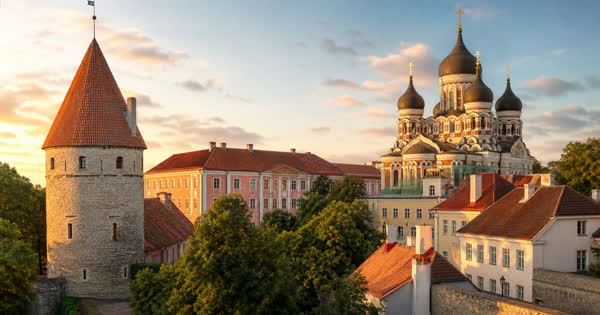
The Alexander Nevsky Cathedral of Tallinn is an Eastern Orthodox cathedral built in 1894-1900, when the country was part of the former Russian Empire. The cathedral is the city's largest cupola church. Built in 1900 under Tsar Alexander III, the Russian Orthodox Cathedral features five gleaming onion domes and an elaborate mosaic façade. It was deliberately placed directly opposite the entrance to Tumpi Castle, the seat of Estonian power, as a symbol of Russian imperial dominance over the local Protestant, Estonian and Baltic German population. After Estonia declared independence in 1918, there were serious proposals to demolish it. Again in 1924 and in the 1930s its demolition was discussed. Each time it survived. Despite past controversy due to its association with Russian occupation, the cathedral has been restored and holds a special place in the hearts of the city's residents, since Estonia regained independence in 1991.
Si ascolta sul posto, con l’app
Toompea Castle
57s
Tumpi Castle has been home to Estonia's parliament, the Riigikogu, since 1922. Located on Tumpi Hill, the castle is rich in history, with roots going back to the 9th century. Over time Crusader knights, Danish kings and Swedish governors rebuilt and expanded it, weaving together medieval ramparts and a graceful baroque façade added during Catherine the Great's reign. Today the castle houses the Riigikogu, Estonia's parliament, where laws are debated beneath vaulted ceilings. Visitors stroll through rose-lined gardens, pausing at tall Hermann Tower, a 45-metre beacon, where the Estonian flag rises each dawn to the national anthem. The pink baroque façade visible today was added in the 18th century by the Russian Empire, making Tumpi Castle a building where every layer of its stone tells a different chapter of Estonian history – Danish, German, Swedish, Russian, and finally independent Estonian.
Si ascolta sul posto, con l’app
Kuldjala Tower
1:01
About 1.85 km of the city wall has survived, as well as 26 defensive towers, two intermediate gates and parts of two front gates. You can walk along a small section of the wall that connects the Nuns, Sauna and Golden Foot Towers, which were built in the 14th century. The wall offers a wonderful view of the Old Town and Toompea Castle. The three ancient towers still open to the public include Nuna, the Nuns Tower, named after the Cistercian order located to the north in St Michael's Convent, and Sauna Tower, named after the public bathhouse that stood nearby. At the height of Tallinn's Hanseatic power, the full circuit of walls included 26 defense towers. Today this is the longest walkable stretch of the medieval walls. You enter at Vikeklustri 1 and walk the wall connecting all three towers, with views over Toompea Castle on one side, and the Old Town rooftops on the other. Walking this stretch at dusk, with the red-tiled rooftops below, gives the clearest sense of how the medieval city defended itself for 600 years.
Si ascolta sul posto, con l’app
Il racconto completo si ascolta sul posto, con l’appContenuti audio geolocalizzati su Voxter