Built in 1568 by Mordechai Meisel, the mayor of the Jewish town, the High Synagogue stands as one of Prague's finest Renaissance gems. Its name comes from its original location. The prayer hall sat on the upper floor, above the Jewish town hall offices below. For centuries, it served the heart of the Jewish quarter, witnessing expulsions, fires, and remarkable revivals. Today, its walls still hold the echoes of a community that shaped Prague's intellectual and cultural life for over 400 years. Step closer. History breathes through every stone.
Si ascolta sul posto, con l’app
Statue of Judah Loew ben Bezalel
39s
standing guard outside the New Town Hall. This striking statue honors Rabbi Judah Loh ben Bezalel, one of the most remarkable figures of 16th century Prague. Born around 1520, the Maharal, as he was known, served as chief rabbi and transformed this city into a center of Jewish scholarship. He debated theology with Emperor Rudolf II himself right here in Prague. Legend later wove around him the myth of the golem, a creature of clay brought to life to protect the Jewish ghetto. The statue, sculpted by Ladislav Shaloun in 1910, captures that legacy in bronze forever.
Si ascolta sul posto, con l’app
Church of St. James the Greater
38s
Step inside one of Prague's oldest sacred spaces. Founded in 1232 by Franciscan friars under King Wenceslas I, this church witnessed centuries of Bohemian history unfold around it. Destroyed by fire in 1689, it was magnificently rebuilt in Baroque style, revealing the resilience of the city's faith and artistry. Look up. The interior is adorned with over 20 altars. Most hauntingly, a shriveled human arm hangs near the entrance, a medieval relic of a thief who attempted to steal a jewel from the Virgin's statue. History here is not just stone. It has teeth.
Si ascolta sul posto, con l’app
Kinský Palace
38s
Standing before you is one of Prague's finest Baroque masterpieces, completed in 1765 by the architect Anselmo Lurago. The Kinski family, powerful Bohemian nobles, shaped this palace into a symbol of aristocratic ambition. But history took a dramatic turn here in February 1948, when communist leader Clement Gottwald addressed the crowds from this very façade, announcing the coup that would seal Czechoslovakia's fate for decades. Even more curious, a young Franz Kafka attended the German school housed within these walls. One building, centuries of stories, revolutions, and genius layered beneath its elegant pink stucco.
Si ascolta sul posto, con l’app
Jewish Town Hall
41s
Standing before you is one of Prague's most remarkable survivors. Built in 1577 by Mordechai Meisel, the wealthy mayor of the Jewish Quarter, this town hall became the administrative heart of Jewish Prague. Its famous clock tower holds two clock faces, one with Roman numerals running clockwise, another with Hebrew letters running counterclockwise, following the direction of Hebrew script. During centuries of persecution, this building stood as a symbol of Jewish self-governance within the ghetto walls. Remarkably, it survived the massive demolition of Yosefov in the 1890s, when most of the old quarter was raised. Today, it still serves the Jewish community.
Si ascolta sul posto, con l’app
Jewish Museum
40s
You're standing at the heart of one of the oldest Jewish communities in Europe. The Jewish Museum in Prague isn't a single building. It's a constellation of sacred sites scattered across Josefow, the former ghetto. Founded in 1906, it preserves centuries of history. The hauntingly beautiful Pincus Synagogue, where 80,000 Holocaust victims' names are inscribed on its walls, and the old Jewish cemetery, where 12 layers of graves tell of a community forced to bury its dead on top of itself. This place holds the memory of a world nearly erased, and refuses to let it be forgotten.
Si ascolta sul posto, con l’app
Karolinum
38s
You're standing before one of Europe's oldest universities. Founded in 1348 by Holy Roman Emperor Charles IV, the Karolinum is the historic heart of Charles University, the first university in Central Europe. Its Gothic aureole window, jutting elegantly over the street, dates back to the 14th century and is one of Prague's most treasured architectural survivors. Over the centuries, these walls witnessed the lectures of Jan Hus, the great Czech reformer, and the turbulent debates that would reshape religious and intellectual history across the continent. Kings, scholars, and revolutionaries all passed through here.
Si ascolta sul posto, con l’app
Clementinum
40s
What you're standing near was once the most ambitious Jesuit project in Central Europe. Founded in 1556, when Emperor Ferdinand I invited the Jesuits to counter the Protestant Reformation, the Clementinum grew over two centuries into a vast complex of churches, libraries, and astronomical towers. By the 18th century, it had absorbed Charles University itself, becoming the intellectual heart of Bohemia. Its Baroque library hall, completed in 1727, housed one of the finest collections in the empire. Napoleon's troops even stored confiscated books here. Today it remains a monument to centuries of knowledge, power, and religious ambition carved in stone.
Si ascolta sul posto, con l’app
Church of Our Lady before Týn
42s
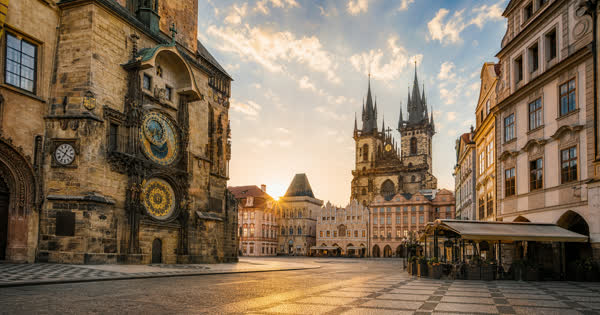
Rising above the Old Town Square since the 14th century, this Gothic masterpiece has witnessed centuries of Bohemian history. Construction began around 1365, and for nearly 200 years it served as the main church of the Hussite movement, the radical reformers who shook medieval Europe long before Luther. Inside rests Tycho Brahe, the eccentric Danish astronomer who mapped the stars for Emperor Rudolf II. The twin towers, asymmetrical by design, reach 80 meters skyward. Behind those golden Madonna and child figures on the façade once stood a golden chalice, the symbol of Hussite faith, melted down after Catholic victory in 1621.
Si ascolta sul posto, con l’app
Prague Astronomical Clock
38s
Installed in 1410, the Prague Astronomical Clock is one of the oldest still-functioning astronomical clocks in the world. Master clockmaker Mikoláš of Kadan built it for the Old Town Hall, and in 1490 it was expanded with the calendar dial below. Legend claims the city council blinded its creator to prevent him from building anything more magnificent elsewhere, a gruesome tale of civic jealousy. Every hour, twelve apostles parade past the windows above, while figures of death, greed, and vanity move in grim warning. Six centuries of history tick quietly on this single medieval face.
Si ascolta sul posto, con l’app
Il racconto completo si ascolta sul posto, con l’appContenuti audio geolocalizzati su Voxter