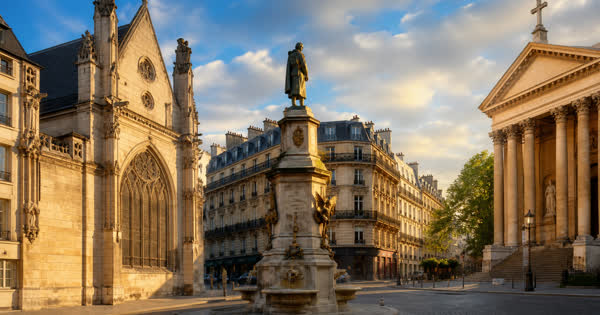
Did you know this is the oldest covered market in Paris, dating back to 1615? It takes its curious name from the orphanage that once stood nearby. Children there wore red uniforms, a color symbolizing charity. Unlike many markets that vanished over centuries, this one survived demolition attempts in the 1990s, thanks to passionate local residents who fought to save it. Today, you'll find Moroccan tagines, Japanese bento, and French cheese side by side under the same iron roof. History never tasted so good.
Plays on location, in the app
Maison de Victor Hugo
40s
Victor Hugo lived here on the Place des Vosges for 16 years. But here's what most visitors never hear. He designed almost every room himself, obsessively, treating his home like a theatrical set. He carved furniture, painted walls, assembled bizarre collages from broken ceramics and scraps of velvet. His study was deliberately dark and cramped. He believed discomfort sharpened his mind. He wrote standing up facing the window watching ordinary Parisians below. Some say the street life he observed here quietly became the soul of Le Miserable. The house wasn't just where he lived, it was where he thought.
Plays on location, in the app
Carrières souterraines des Capucins
36s
Beneath your feet lies one of Paris's best-kept secrets — the underground quarries of the Capucins. Unlike the famous Catacombs, these tunnels were carved to extract the limestone that literally built Paris above ground. For centuries, workers called 'carriers' descended into total darkness, shaping the very bones of the city. Some chambers still bear mysterious inscriptions and crude sculptures left by those forgotten laborers. Today, most passages remain sealed from the public, making every glimpse inside feel like stealing a secret from the stone itself. Paris built its grandeur on shadows.
Plays on location, in the app
Musée des Arts et Métiers
37s
Step inside one of the world's oldest science and technology museums, founded in 1794 during the French Revolution. Originally a royal priory dating back to 1079, the Abbey of Saint-Martin-de-Champs was transformed by the National Convention into a repository for machines, tools, and inventions. Here, Foucault's original pendulum once swung beneath medieval vaults, demonstrating Earth's rotation in 1851. Lavoisier's laboratory instruments, early flying machines, and Lumière's cinema equipment found shelter within these ancient walls, a place where monastic silence met industrial revolution, faith replaced by the unstoppable curiosity of human ingenuity.
Plays on location, in the app
Thermes de Cluny
37s
Beneath your feet lies one of Paris's best-kept secrets, Roman baths built around 300 AD, when this city was still called Lutetia. The Thermes de Cluny are among the best-preserved Roman ruins in all of France, and remarkably, they weren't built by soldiers or emperors, but by the powerful guild of Parisian boatmen. Picture wealthy merchants soaking in steaming pools while Gauls and Romans mingled just steps from the Seine. The frigidarium's vaulted ceiling, still standing today, once echoed with laughter in Latin, 2,000 years of history hiding in plain sight.
Plays on location, in the app
Conciergerie
39s
You're standing near one of Paris's most chilling landmarks. The Conciergerie began as a royal palace, but history remembers it as the city's most notorious prison. During the Reign of Terror, over 2,700 prisoners passed through its gates on their way to the guillotine. Marie Antoinette spent her final weeks here in a bare cell, stripped of all royal privilege. Remarkably, prisoners who could afford it rented better rooms, even ordered meals from outside. Justice and inequality, inseparable until the very end. The medieval towers you see today have witnessed seven centuries of power, betrayal, and fate.
Plays on location, in the app
Monument aux morts de la guerre de 1870
34s
You're standing before a memorial that marks one of France's most painful chapters, the Franco-Prussian War of 1870, when Paris itself was besieged for over four months. Parisians were so desperate for food that they ate animals from the city zoo, including elephants named Castor and Pollux. This monument was erected not just to honor the fallen, but to keep alive the memory of a defeat that reshaped Europe forever. Look closely. Grief and defiance are carved into every line of stone here.
Plays on location, in the app
Église Saint-Ferdinand des Ternes
37s
You're standing before one of Paris's lesser-known gems, Saint-Ferdinand de Ternes, completed in 1848. But here's the remarkable part. This church holds a deeply royal secret. It was built on the very site where Ferdinand-Philippe, Duke of Orléans and heir to the French throne, died tragically in 1842 after leaping from a runaway carriage. His grieving mother, Queen Marie-Amélie, commissioned the chapel as an act of love and mourning. Step inside and you'll find stunning stained glass and sculptures donated by the royal family, a hidden memorial hiding in plain sight.
Plays on location, in the app
Monument à Garibaldi
38s
You're standing near one of Paris's most surprising tributes — a monument to Giuseppe Garibaldi, the Italian hero who unified his own country, yet fought fiercely for France. In 1870, during the Franco-Prussian War, Garibaldi and his volunteer army were among the few forces to actually defeat Prussian troops on French soil. France was collapsing, yet this Italian general refused to abandon her. Victor Hugo called him 'the only general undefeated in this war.' Not bad for a man who wasn't even French. Look around — Paris honors its true friends, regardless of nationality.
Plays on location, in the app
Église Saint-Merri
35s
Step closer. This Gothic church hides one of Paris's best-kept secrets. Built between 1500 and 1612, St. Mary stands on the site where St. Mary, a 7th-century abbot, was actually buried. But here's the surprising part. The church houses the oldest bell in Paris, cast in 1331. It rang through the Hundred Years' War, the Revolution, and two World Wars. Composer Camille Saint-Saëns served as organist here early in his career. Stand still for a moment and listen. That silence carries seven centuries of Parisian life.
Plays on location, in the app
The full story plays on location, in the appLocation-based audio on Voxter