← All places in Oslo Oslo: History at the Heart of the City

Oslo: History at the Heart of the City

8 stops 71 min oslo

From the waterfront to Parliament, explore Oslo's iconic landmarks: museums, historic squares and monuments that tell centuries of Norwegian culture in a scenic walk through the city centre.

The stops

1

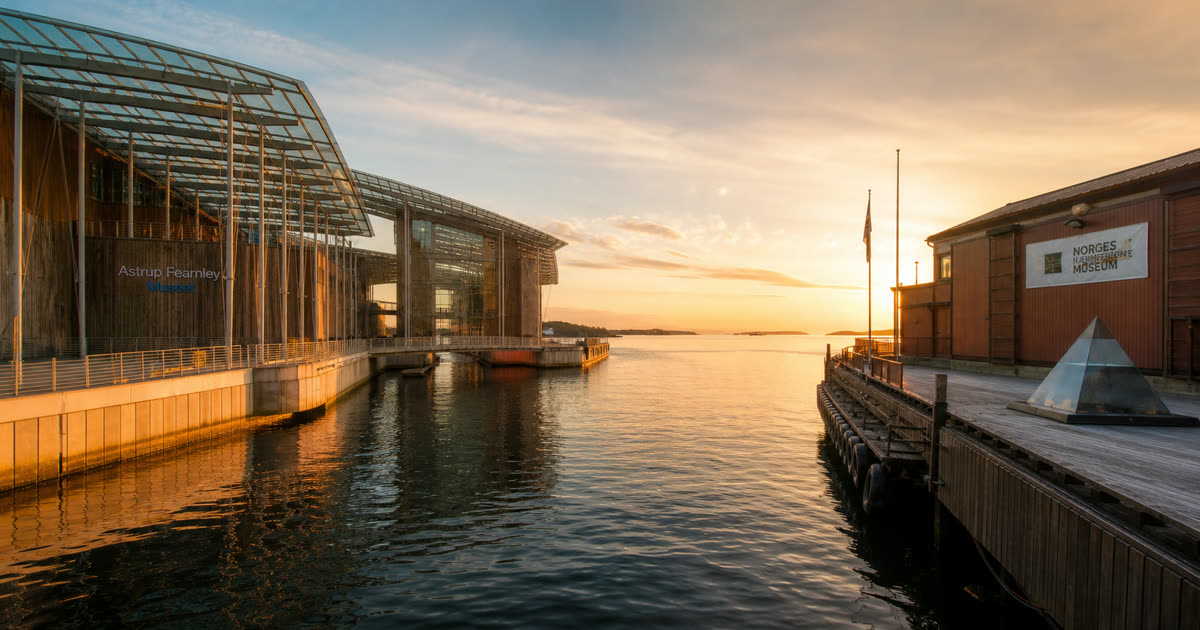
Astrup Fearnley Museet

36s

This striking waterfront museum carries the legacy of two powerful Norwegian dynasties. Hans Rasmus Astrup and the Fearnley Shipping Family were among Norway's most passionate art collectors in the 20th century. Their combined collections, assembled over decades, became the foundation of this institution, officially opened in 1993. Renzo Piano later redesigned the building in 2012, placing it dramatically on the Tjuvholmen Peninsula. The museum preserves works acquired during a golden era of private patronage, when Norwegian industrialists believed art was not a luxury, it was a civic duty.

Plays on location, in the app
2

Oslo City Hall

42s

Standing before you is Oslo City Hall, inaugurated in 1950 after nearly two decades of construction delayed by World War II and the Nazi occupation of Norway. The building was conceived in the 1910s by architects Arnstein Arneberg and Magnus Poulsen, envisioned as a bold civic monument to Norwegian democracy. During the occupation, German forces requisitioned the site, but Norwegians reclaimed it triumphantly at war's end. Today the hall is famous worldwide as the venue where the Nobel Peace Prize is awarded every December 10th, the anniversary of Alfred Nobel's death, drawing global leaders and laureates to its grand mural-covered main hall.

Plays on location, in the app
3

Norges hjemmefrontmuseum

39s

Standing right by Akershus Fortress, this museum tells the gripping story of Norwegian resistance during the Nazi occupation from 1940 to 1945. When German forces invaded in April 1940, ordinary Norwegians—teachers, priests, students—quietly became spies, saboteurs, and underground publishers. The illegal newspaper network alone distributed over a million copies. Executed resistance fighters were imprisoned in these very fortress walls, established in 1970. The museum preserves their courage through documents, weapons, and personal testimonies. This is not a distant history. It happened on these streets, to real people who chose defiance over surrender.

Plays on location, in the app
4

Storting

39s

Standing before you is the Storting, Norway's parliament, completed in 1866 after decades of national debate. Architect Emil Victor Langlett designed this yellow brick building in a Neo-Renaissance style, deliberately positioned facing the Royal Palace, a symbolic dialogue between democracy and monarchy. When Norway declared independence from Sweden in 1905, these halls echoed with historic votes that reshaped a nation. The Storting has witnessed constitutional crises, Nazi occupation during World War II, and the resilient return of Norwegian democracy in 1945. Over 150 years, every major chapter of modern Norwegian history has passed through these doors.

Plays on location, in the app
5

Theatercaféen

38s

Step inside one of Oslo's most storied grand cafés, open since 1900. Theater Caféen became the living room of Norway's cultural elite. Henrik Ibsen himself was a regular, occupying his favorite corner table with almost ritual precision. Writers, painters, and politicians gathered beneath its ornate mirrors and vaulted ceilings, debating ideas that would shape a nation. During the German occupation in World War II, it remained a charged, whispered meeting point for resistance sympathizers. Over a century later, the chandeliers still glow, and the walls seem to remember every conversation ever held beneath them.

Plays on location, in the app
6

Eidsvolls plass

37s

You're standing on one of Oslo's most historically charged squares. Eidsvollsplass takes its name from Eidsvoll, where Norway's constitution was signed on May 17, 1814, the document that broke centuries of Danish rule and laid the foundation of the modern Norwegian state. The square was designed as a grand ceremonial forecourt to the Storting, Norway's parliament, built between 1861 and 1866. Here, generations of Norwegians have gathered to celebrate, protest, and bear witness to democracy in action. That fountain at the center? It marks the very heart of constitutional Oslo.

Plays on location, in the app
7

Universitetsplassen

40s

You're standing on one of Oslo's most historically charged squares. Universitetetsplassen was shaped in the early 19th century as part of a grand vision to give the young Norwegian nation a monumental heart. When Norway broke free from Danish rule in 1814, the new state needed institutions of its own. The University of Oslo was founded that very year, and this neoclassical square became its ceremonial stage. King Carl Johan personally championed the urban plan, and the buildings that frame this space, completed by the 1850s, were designed to project intellectual power and national pride to the world.

Plays on location, in the app
8

National Gallery

38s

Founded in 1837, the National Gallery is Norway's oldest and largest public art museum, and the building itself carries a century and a half of cultural ambition. It was constructed in 1882, when Oslo was still called Christiania, and immediately became the crown jewel of the nation's artistic identity. Most famously, it houses Edvard Munch's original version of The Scream, painted in 1893. During World War II, Nazi occupiers attempted to exploit Norwegian art for propaganda. Curators risked everything to protect the collections. Step inside and walk through Norway's soul, brushstroke by brushstroke.

Plays on location, in the app
The full story plays on location, in the appLocation-based audio on Voxter
Get Voxter