Welcome to one of London's most hidden treasures. Built in 1863, St. Peter's Italian Catholic Church has been the spiritual heart of the Italian community in Clerkenwell. Once so densely populated by Italians, it was nicknamed Little Italy. The church became a refuge for immigrants fleeing poverty and revolution, but also a place of tragedy. During World War II, hundreds of Italian men were arrested nearby and deported as enemy aliens. Some perished when their ship was torpedoed. Step inside and you'll find breathtaking frescoes that feel entirely out of place in grey London, a slice of Rome hiding in plain sight.
Plays on location, in the app
British Museum
38s
Right here stands one of the world's greatest treasure houses, and it's completely free to enter. The British Museum holds over 8 million objects, but here's the jaw-dropping part. Less than one percent is ever on display at once. Beneath your feet, vast underground vaults hide countless artifacts still waiting to be studied. And that iconic glass-and-steel Great Court roof? It was hidden under offices for over 150 years before being unveiled in 2000. The Reading Room inside once welcomed Karl Marx, who wrote Das Kapital right there among the shelves. History literally surrounds you.
Plays on location, in the app
Palace of Westminster
40s
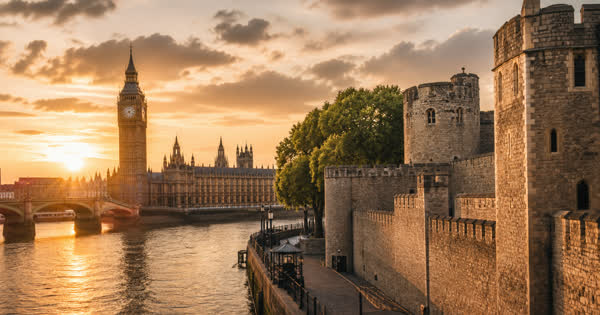
You're standing before one of the world's most iconic buildings. And here's something that might surprise you. The famous clock tower wasn't called Big Ben until recently. Big Ben actually refers to the massive bell inside, not the tower itself. The tower was officially renamed Elizabeth Tower in 2012 to honor the Queen's Diamond Jubilee. Built after a devastating fire in 1834, this Gothic masterpiece took over 30 years Nearly 1,000 rooms hide behind that riverside facade. Look closely at the stonework. It's slowly crumbling, requiring one of Britain's most expensive restoration projects ever attempted.
Plays on location, in the app
Tower of London
36s
You're standing before one of the most feared buildings in history. For centuries, the Tower of London wasn't just a fortress. It was a place of dread. Anne Boleyn, Henry VIII's second wife, was beheaded right here in 1536. But here's the surprising part. According to legend, if the Tower's famous ravens ever leave, the crown and the kingdom will fall. So today, a raven master is officially employed by the royal family just to keep those birds here. History, superstition, and royal power all in one place.
Plays on location, in the app
The Monument to the Great Fire of London
38s
You're standing near one of London's most quietly brilliant landmarks. This towering column, completed in 1677, was designed by Christopher Wren and Robert Hooke to commemorate the Great Fire of 1666, which destroyed over 13,000 homes in just four days. Here's the clever part. Its height, exactly 202 feet, matches the precise distance from its base to the bakery on Pudding Lane, where the fire allegedly started. It's essentially a giant measuring stick frozen in stone. Climb its 311 steps and you'll earn a breathtaking view and a certificate to prove it.
Plays on location, in the app
10 Downing Street
50s
The modest black door at 10 Downing Street has been the official residence of British Prime Ministers since 1735, when King George II offered the house to Sir Robert Walpole, considered the first Prime Minister of Great Britain. Walpole accepted it not for himself but for the office, establishing the tradition that the house belongs to the role, not the person. The street itself is named after Sir George Downing, a diplomat and spy who built the terraced houses in the 1680s. The building appears small from the outside but connects to a far larger structure behind. There are over 100 rooms. The door itself is peculiar. It has no keyhole on the outside. It can only be opened from within by a doorkeeper. Every visitor, regardless of rank or status, must knock. Every Prime Minister from Walpole to the present has walked through the same black door.
Plays on location, in the app
Buckingham Palace
52s
Buckingham Palace was originally known as Buckingham House, built in 1703 for the Duke of Buckingham. In 1761, King George III bought it for his wife Queen Charlotte as a family residence. In the 1820s, it was refurbished at the behest of George IV and became Buckingham Palace. Queen Victoria moved here in 1837 and became the first monarch to use it as an official residence. William IV, who preceded Victoria, had offered the almost-completed palace to Parliament after the 1834 fire destroyed Westminster. Parliament rejected it as unsuitable. The palace has 775 rooms. The 19 staterooms are open to visitors in summer. In the lantern room on the roof, a small boy of 12 lived undetected for a year during Queen Victoria's reign, hiding in the chimneys. A true story that inspired the 1949 novel, The Mudlark.
Plays on location, in the app
Palace of Westminster Big Ben
56s
On 16 October 1834, a fire broke out in the Palace of Westminster after an overheated stove used to destroy the Exchequer's stockpile of tally sticks set fire to the House of Lords chamber. Both Houses of Parliament were destroyed, along with most of the other buildings in the Palace complex. Westminster Hall was saved by firefighting efforts and a change in wind direction. The Gothic Revival Palace you see today was designed by Charles Barry and Augustus Pugin and completed in 1870. The Elizabeth Tower, universally known as Big Ben after its largest bell, is 96 metres tall. The original hour bell cracked during testing and was recast. The present bell later developed a crack of its own, which gives it a distinctive sound. The Ayrton light at the top of the tower is lit whenever either House of Parliament is sitting after dark. It was installed in 1885 at the request of Queen Victoria, so she could see from Buckingham Palace whether her Members of Parliament were at work.
Plays on location, in the app
Westminster Abbey
55s
Westminster Abbey has been the coronation church of English and British monarchs since 1066. William the Conqueror was the first to be crowned here on Christmas Day of that year. Over three, three hundred people are buried or commemorated in the Abbey. Since the 18th century, burial here has been considered the highest honour for any British person. A practice boosted by the lavish funeral of Isaac Newton in 1727. Poets' Corner contains the graves and memorials of Chaucer, Shakespeare, Dickens, Kipling, Hardy, Tennyson, and many others. The Coronation Chair, the oldest piece of furniture still used for its original purpose in England, has been used at every coronation since 1308. Beneath it sat the Stone of Destiny, removed from Scotland by Edward I in 1296, returned to Scotland in 1996, and brought back to Westminster for the coronation of Charles III in 2023. The Abbey has been a UNESCO World Heritage Site since 1987.
Plays on location, in the app
Tower of London Crown Jewels
1:00
The crown jewels have been stored at the Tower of London since 1303, after they were stolen from Westminster Abbey, a theft so audacious that it prompted their permanent relocation to the Tower. The collection includes the Imperial State Crown, worn by the monarch at the State Opening of Parliament, which contains two, 868 diamonds, 17 sapphires, 11 emeralds, and 269 pearls. It also contains the Black Prince's ruby, a 170-carat red spinel, not actually a ruby, worn by Henry V, at the Battle of Agincourt, in 1415. The oldest piece in the collection is the Anointing Spoon, dating from the 12th century, the only item to survive the destruction of the original crown jewels, ordered by Oliver Cromwell in 1649. The collection is guarded by the Yeoman Warders, the beef-eaters, who have lived within the Tower Walls since 1485. There are currently 37 Yeoman Warders, all retired senior non-commissioned officers from the British Armed Forces.
Plays on location, in the app
The full story plays on location, in the appLocation-based audio on Voxter