← Tutti i luoghi di Dublin Dublino Storica: il Cuore di O'Connell Street

Dublino Storica: il Cuore di O'Connell Street

7 tappe 40 min Dublino

Cammina tra i luoghi che hanno plasmato l'anima di Dublino: dalla rivolta del 1916 ai teatri d'epoca, passando per architetture georgiane e il fiume Liffey. Storia viva ad ogni passo.

Le tappe del percorso

1

Tyrone House

39s

Standing before you is Tyrone House, one of Dublin's finest Georgian mansions, built in 1740 by the celebrated architect Richard Castle for Sir Marcus Beresford, Viscount Tyrone. Castle, who also designed Leinster House and Powerscourt, gave this townhouse an elegant Palladian façade that was considered among the most sophisticated in the city. By the 19th century, the Irish Board of Education took residence here, shaping national schooling for generations. Its grand rooms, once filled with aristocratic gatherings, became the quiet engine of Irish public education, a remarkable transformation from noble privilege to public service written in Portland stone.

Si ascolta sul posto, con l’app
2

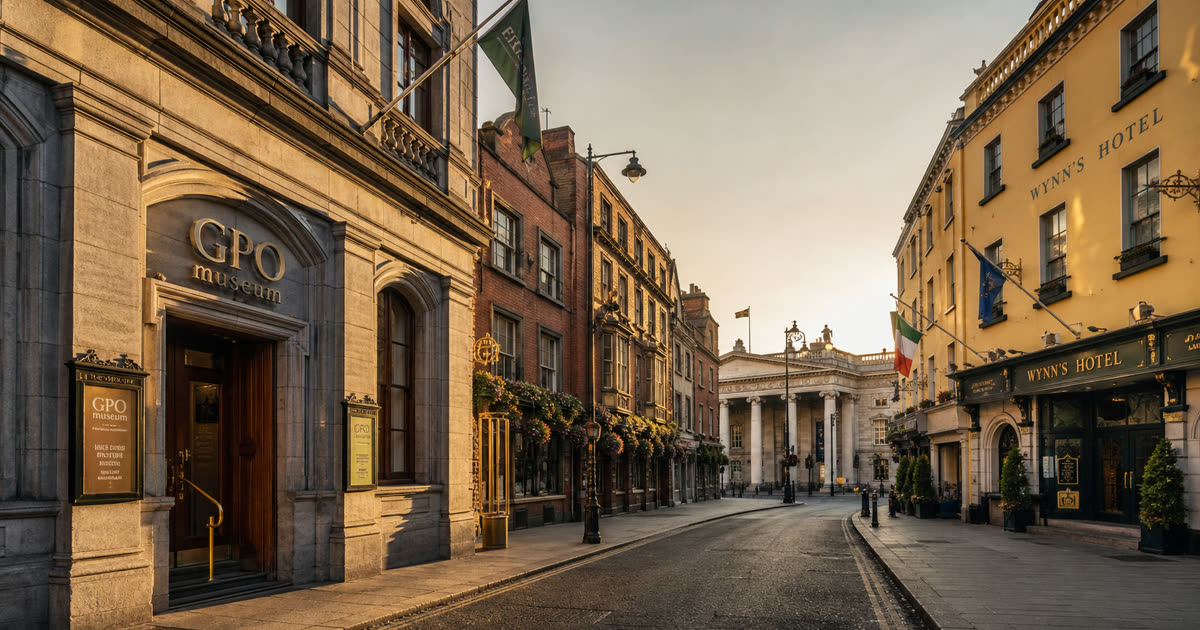
GPO Museum

38s

Ti trovi nel cuore della storia irlandese. L'Ufficio Postale Generale non era solo un ufficio postale — divenne il quartier generale del Levantamento pasquale del 1916, quando Patrick Pearse lesse il Proclama della Repubblica Irlandese dai suoi iconici scalini. Le forze britanniche bombardarono l'edificio, lasciandolo in rovina dopo sei giorni di feroci combattimenti. I ribelli si arresero e i loro capi furono giustiziati, ma la ribellione accese una rivoluzione. Oggi, il Museo GPO all'interno ti guida attraverso quella settimana cruciale con straordinari artefatti, testimonianze personali e mostre immersive che portano il 1916 vivacemente in vita.

Si ascolta sul posto, con l’app
3

Capitol Theatre

42s

Standing here, you're on the site of one of Dublin's most beloved entertainment landmarks. The Capitol Theatre opened in 1920, rising on the ruins of a city still scarred by the 1916 rising. It was built by Irish architects and became a glamorous destination for Dubliners hungry for cinema and live performance during decades of political upheaval and economic hardship. Hollywood stars flickered on its screen while the Irish Free State was being forged outside its doors. The Capitol welcomed generations of Dubliners until its demolition in 1972, making way for modern redevelopment, a fate that erased one of the city's grandest architectural memories.

Si ascolta sul posto, con l’app
4

Clerys

40s

Standing before you is Clarice, one of Dublin's most iconic department stores. Built in 1853, it was originally known as the Imperial Hotel before being transformed into a grand retail palace. Its neoclassical facade witnessed some of Ireland's most dramatic history. During the 1916 Easter Rising, Patrick Pearce and James Connolly famously used the GPO just opposite as their headquarters, while Clarice itself bore the scars of battle. Rebuilt in 1922 after the destruction of the Rising, the store became a beloved Dublin landmark for over a century, its famous clock a traditional meeting point for generations of Dubliners.

Si ascolta sul posto, con l’app
5

Wynn's Hotel

40s

Standing before you is Wynn's Hotel, one of Dublin's most historically charged addresses. Built in the mid-19th century, it became a quiet nerve center of Irish nationalism. In the tense weeks before the 1916 Easter Rising, key figures of the Irish volunteers gathered here to plan and coordinate their rebellion against British rule. The hotel's modest façade concealed conversations that would reshape a nation. Even earlier, it served clergy and merchants arriving into the city, witnessing the full sweep of Victorian Dublin life. Few buildings on O'Connell Street carry such a layered, conspiratorial past hidden behind such an ordinary exterior.

Si ascolta sul posto, con l’app
6

Abbey Theatre School

38s

You're standing near one of Ireland's most legendary cultural institutions. The Abbey Theatre, founded in 1904 by W.B. Yeats and Lady Augusta Gregory, became the beating heart of the Irish literary revival. Its early productions sparked riots. Famously, Singe's Playboy of the Western World in 1907 outraged audiences who stormed the stalls. The theatre nurtured voices that shaped modern Irish identity, from Sean O'Casey to Samuel Beckett. Destroyed by fire in 1951 and rebuilt, it survived turbulent history much like Ireland itself. The school here carries that fierce, rebellious spirit forward into new generations.

Si ascolta sul posto, con l’app
7

Eden Quay

40s

Standing here on Eden Quay, you're treading ground shaped by centuries of Dublin's turbulent past. This stretch along the Liffey was developed in the 18th century as the city expanded northward, transforming marshy riverbanks into a bustling commercial artery. During the 1916 Easter Rising, Eden Quay became a flashpoint of rebellion. British gunboats on the Liffey fired shells inland, and the nearby Liberty Hall, headquarters of the Irish Citizen Army, was bombarded into ruins. The Quay witnessed crowds, chaos, and the birth pangs of a nation. Today, the river flows quietly, but the stones beneath your feet remember everything.

Si ascolta sul posto, con l’app
Il racconto completo si ascolta sul posto, con l’appContenuti audio geolocalizzati su Voxter
Scarica Voxter