The Round Tower, built in the 17th-18th century, is Europe's oldest functioning observatory and is used extensively by amateur astronomers. Once you get to the top via the spiral ramp, you'll see a striking view of Copenhagen from a viewing platform running around the tower. Horses used to drag carts loaded with books up to the university library at the top, hence the spiral ramp, instead of stairs. The equestrian ramp, 7.5 turns of a continuous spiral, 280 metres long with no steps, was designed specifically so that horse-drawn carts could carry books to the library at the top. In 1770, Tsar Peter the Great of Russia visited Copenhagen and rode HIS horse to the top of the tower. His wife Catherine followed in a carriage. The tower is still used by amateur astronomers every winter, one of the oldest continuously operating observatories in Europe.
Si ascolta sul posto, con l’app
Christiansborg Palace Ruins
56s
Numerous fires throughout the ages were unfortunately disastrous for the old market town environment. In 1728, a great fire destroyed no less than 1,640 buildings, including five churches, the city hall and the university. In 1794, a new fire broke out and among other places it affected the former royal palace Christiansborg. The following year, a fourth of Copenhagen, approximately 950 houses, burned down. The current neoclassical building is the fifth structure to stand on the same site. Each predecessor either burned or was demolished. The tower of Christiansborg is the only part of the palace open to the public for free and it offers the highest publicly accessible viewpoint in Copenhagen. From the tower platform you can see the entire city, the harbour and on clear days the coast of Sweden across the Årsend.
Si ascolta sul posto, con l’app
Amalienborg Palace
1:00
The area known as Frederick Staden, developed by Frederick V in the second half of the 18th century in the Rococo style, has the four mansions of Amalienborg, the royal residence, and the wide-domed marble church at its centre. Amalienborg is not a single palace but four identical Rococo mansions, arranged around an octagonal courtyard, built simultaneously between 1750 and 1760 for four noble families. The royal family moved here in 1794 after Christiansborg burned down. At the centre of the courtyard stands the equestrian statue of Frederick V, commissioned from the French sculptor Jacques Sally in 1753. It took 20 years to complete and cost more than the four palaces surrounding it. Every day at noon, when the monarch is in residence, the changing of the guard takes place in the courtyard. The royal lifeguard marches from Rosenborg Barracks at 11.30 and arrives here at noon. It is free to watch and one of the most elegant military ceremonies in northern Europe.
Si ascolta sul posto, con l’app
Stroget
55s
The name Copenhagen comes from the words for Merchant Harbour, Koppmannet Hafen, in Old Danish. Stroget, pronounced roughly Stroi Et, is the main pedestrian street of Copenhagen, running 1.1 kilometers from City Hall Square to Kongens Nytorv. It is one of the longest pedestrian shopping streets in Europe, first pedestrianized in 1962 as an experiment. At the time, Danes were deeply skeptical that removing cars from a shopping street would work. It became a model for pedestrian urban planning across the world. The urban designer Jan Gehl, who later transformed public space thinking worldwide, used Stroget as one of his key case studies. Walking the full length from City Hall Square to Kongens Nytorv takes about 15 minutes without stopping, passing from department stores and high street shops at the western end to jewellers, designer boutiques and the Royal Copenhagen porcelain flagship store at the eastern end.
Si ascolta sul posto, con l’app
Round Tower
57s
The Round Tower, built in the 17th century, is Europe's oldest functioning observatory, and is used extensively by amateur astronomers. Once you get to the top via the spiral ramp, you'll see a striking view of Copenhagen from a viewing platform running around the tower. Horses used to drag carts loaded with books up to the university library at the top, hence the spiral ramp instead of stairs. The Runde Tarn was built between 1637 and 1642 by King Christian IV, as part of a university complex that included a library and a church. The equestrian ramp, 7.5 turns of a continuous spiral 210 metres long with no steps, was designed specifically so that horse-drawn carts could carry books to the library at the top. In 1716, Tsar Peter the Great of Russia visited Copenhagen and rode his horse to the top of the tower. His wife Catherine followed in a carriage. The tower is still used by amateur astronomers every winter. One of the oldest continuously operating observatories in Europe.
Si ascolta sul posto, con l’app
Christiansborg Palace
54s
Christiansborg Palace stands on the site of Absalon's castle from 1167. Bishop Absalon, the founder of Copenhagen, built the original fortress on this island to defend the fishing village. The current palace is the fifth building to stand on the same site. The first was Absalon's medieval castle, demolished by the Hanseatic League in 1369. The second was a Renaissance palace. The third and fourth burned down in 1794 and 1884 respectively. The current neoclassical building was completed in 1928. It is the only building in the world that houses all three branches of a country's government simultaneously. The Danish Parliament, the Supreme Court and the Prime Minister's Office all share the same palace. The royal reception rooms are used by the royal family for state functions. Beneath the palace, the ruins of Absalon's original 12th-century castle are visible through a dedicated archaeological exhibition in the basement.
Si ascolta sul posto, con l’app
The Little Mermaid
1:02
The Little Mermaid statue, unveiled in 1913, depicts a mermaid transforming into a human. Inspired by Hans Christian Andersen's fairy tale, it was commissioned by brewer Karl Jakobsen. The statue was sculpted by Edvard Erikson, and has sat on its rock at the entrance to Copenhagen harbour for over 110 years. It is 1.25 metres tall, far smaller than most visitors expect, having imagined something monumental from the photographs. It is also one of the most vandalised artworks in the world, decapitated twice, in 1964 and 1998. Its arms sawn off in 1984, repeatedly painted, and blown off its rock by explosives in 1984. Each time it has been repaired from the original cast. The original casting mould is still kept by Erikson's family, who retain the copyright. Every reproduction of the statue requires their permission. The figure that has become the symbol of Copenhagen was created by a single brewer's enthusiasm for a ballet performance of the fairy tale he had seen the night before.
Si ascolta sul posto, con l’app
Nyhavn
59s
To the south of Frederiksstaden, the Nyhavn canal is lined with colourful houses from the 17th and 18th centuries, many now with lively restaurants and bars. The canal runs from the harbour front to the spacious square of Kongens Nytorv, which was laid out by Christian V in 1670. Nyhavn, meaning New Harbour, was constructed between 1671 and 1673 as a commercial port to allow ships to unload their goods directly into the city centre. For most of its history it was a working harbour lined with warehouses, sailors, taverns and brothels, one of the roughest parts of Copenhagen. Hans Christian Andersen lived at three different addresses along Nyhavn during his life, at No. 20, No. 67 and No. 18, where he wrote some of his most famous fairy tales including The Tinderbox, Little Claws and Big Claws, and The Princess and the Pea. Today the colourful facades and canal are one of the most photographed images in Scandinavia, a 17th century working dock transformed into a postcard.
Si ascolta sul posto, con l’app
Rosenborg Castle
53s
The Knights' Hall, with its silver throne and three silver lions, is one of the most extraordinary rooms in Northern Europe. Among the main attractions is the Knights' Hall with the coronation thrones, decorated with narwhal tusks, with three life-size silver lions standing guard. Tapestries on the walls commemorate battles between Denmark and Sweden. Between 1685 and 1693, Christian V commissioned 12 woven tapestries for the Knights' Hall, marking his victories in the Scanian War of 1675–1679. The iconic emerald set, worn by H.M. Queen Mary after the succession of the throne in 2024, is the only set among the Crown Jewels to include a tiara when it was originally created, during the 1840s. The Danish Crown Jewels cannot leave the country. They can only be worn by the reigning monarch within Danish borders, which makes Rosenborg their permanent home.
Si ascolta sul posto, con l’app
Rosenborg Castle
55s
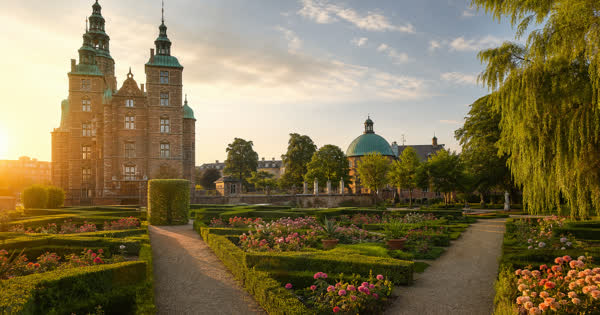
Rosenborg Castle is a Renaissance castle in Copenhagen. The castle was originally built as a country summer house in 1606 and is an example of Christian IV's many architectural projects. It was built in the Dutch Renaissance style and has been expanded several times, finally evolving into its present condition by the year 1624. Christian IV first refers to Rosenborg as his great house in the garden in 1624. Of special interest to tourists is a treasury displaying the crown jewels and the Danish crown regalia located in the castle. The throne chair of Denmark is located in the castle. Following the fire at the first Christiansborg Palace, Rosenborg Castle was temporarily used as a royal residence. Rosenborg Castle once again served as emergency housing during the British attack on Copenhagen. Christian IV died in his bedchamber at Rosenborg in 1648, the same room visitors can see today.
Si ascolta sul posto, con l’app
Il racconto completo si ascolta sul posto, con l’appContenuti audio geolocalizzati su Voxter