Brussels is the world capital of fine chocolate, not in terms of production, but in terms of density of matres chocolatiers per square kilometre. In the Galerie Royale Saint-Hubert and the surrounding streets, historic delicatessens, breweries and cafes are concentrated within just a few metres of each other. The tradition of Belgian chocolate dates back to the late 19th century, when Jean Newhouse invented the filled praline in 1912 in his shop right here in the Galerie Saint-Hubert. That same shop still exists today, at numbers 25 to 27 in the Galerie de la Reine. Belgian beers number over 1,500 different varieties. The Trappist beers produced by Benedictine monks are considered the finest in the world. The historic café Au Bon Vieux Tombe, in a side alley near the Grand Place, has been serving Belgian beers since 1695, the very year the French cannons destroyed the square. It reopened before the square had even been rebuilt.
Plays on location, in the app
Musée BELvue
44s
Beneath the Place Royale lie the ruins of the destroyed and buried Palace of Koudenberg, one of the oldest buildings in Brussels. It was the principal residence of the Dukes of Brabant from the 12th century and later of the Habsburgs. Charles V lived here permanently. In 1731, a fire devastated it completely. Instead of rebuilding, the authorities covered it with earth and constructed the current neoclassical Place Royale on top. For over two centuries the palace lay buried beneath the square, until excavations in the 1980s uncovered the remains of the imperial halls, the chapel, and the corridors. It is now accessible through an entrance in the Bellevue Museum – you literally descend beneath the square into the palace where Charles V signed imperial documents.
Plays on location, in the app
Atomium
48s
The Atomium, a 103-metre-tall representation of an iron crystal, was built for the 1958 World's Fair, and has been preserved ever since, becoming a kind of Belgian equivalent of the Eiffel Tower. It was created for Expo 58 and, although originally intended for demolition, was so popular with local residents that it became a permanent feature of the city's skyline. The nine iron atoms of the structure, stainless steel spheres each 18 metres in diameter, are connected by tubes that can be walked through from the inside. The topmost atom houses a panoramic restaurant. The structure represents an iron molecule enlarged 165 billion times, a deliberate choice to symbolise the nuclear age and the scientific progress that the 1958 Expo was celebrating. It was designed by engineer Andre Waterkeyn.
Plays on location, in the app
Palais de Justice
46s
The Palace of Justice was built between 1866 and 1883 by architect Joseph Pollut. It was commissioned by Leopold II and may have been the largest building constructed in the 19th century. It covers a surface area of 26,000 square meters, larger than St. Peter's Basilica in Rome. Its construction required the demolition of an entire working-class district. Tens of thousands of people were evicted to make way for the building. The residents of that neighborhood never forgave Pollut. They nicknamed him Skeev Architect, the Crooked Architect, and his name became a vulgar term in the local dialect that Brussels residents still use today. His statue was repeatedly vandalized after his death. The building can be seen from almost anywhere in the city. It is built on a hill and dominates the urban skyline.
Plays on location, in the app
Cathédrale Saints-Michel-et-Gudule
46s
The Cathedral of Brussels is a grand Gothic Brabantine building erected from 1226 onwards, rich in works of art. Construction lasted over three centuries, begun in 1226, it was completed in its current form only in the 16th century. It is dedicated to two patrons, the Archangel Michael and Saint Gudula, a noblewoman who lived in the 7th century. Beneath the central nave, during 20th century restoration work, the remains of an earlier Romanesque church from the 11th century were uncovered, along with an even older Carolingian chapel. Three churches superimposed, Carolingian, Romanesque, Gothic, on the same spot. Today, the cathedral hosts royal weddings and funerals in Belgium. It is the site where the official ceremonies of the monarchy are held.
Plays on location, in the app
Galeries Royales Saint-Hubert
50s
The Galeries Royale Saint-Hubert is a historic and refined structure that remains an elegant meeting place in the city today, with tables beneath its arcades, bookshops, delicatessens, breweries and cafés. It was inaugurated on 20 June 1847 by King Leopold I. It is one of the first covered shopping galleries in Europe, predating the great arcades of Paris and Milan. The iron and glass vault illuminates a gallery 213 metres long with three branches, the Galerie du Roi, the Galerie de la Reine, and the Galerie des Princes. It was designed by architect Jean-Pierre Clousonnet in neoclassical style. Victor Hugo frequented it during his exile in Brussels between 1851 and 1861. Karl Marx lived nearby when he wrote the Communist Manifesto here in 1848, sent to press from Brussels.
Plays on location, in the app
Grand Place
56s
At the beginning of July, the Grand Place hosts the Omegang, one of the greatest historical pageants in Europe. It features a lavish procession in period costume of over 1,400 participants, commemorating a similar event that took place in 1549, in the presence of Emperor Charles V, his sister Eleanor of Habsburg, and his son Philip II of Spain. Every even year, on the weekend of 15 August, the Feast of the Assumption, the Grand Place is covered by an immense flower carpet, 25 metres wide and 75 metres long, made from more than 500,000 begonia plants. In 1856, a monumental fountain was installed at the centre of the square, to commemorate the 25th anniversary of the reign of Leopold I. The Grand Place is therefore a square that continues to be used, not merely contemplated. It has hosted coronations, executions, markets, protests and flower carpets without interruption for six centuries.
Plays on location, in the app
Manneken Pis
43s
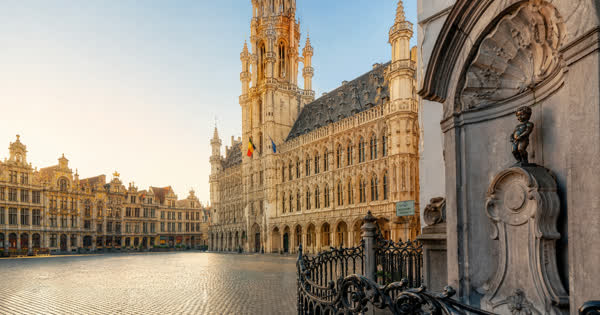
The Manneken Pis is a small bronze statue by sculptor Jerome du Canoy, depicting a boy urinating into a fountain. It was cast in 1619. Standing just 50cm tall, it is one of the most visited monuments in Europe, and one of the most disappointing for those expecting something imposing. The original statue is displayed at the Maison du Rhin on the Grand Place, alongside around a thousand costumes worn by the figure over the centuries, collected from governments, associations and public figures around the world, who have gifted it national costumes, uniforms and folk dress. What you see on the fountain is a copy. The Manneken Pis is dressed in different outfits more than a hundred times a year. The city of Brussels publishes an official calendar of his costumed appearances.
Plays on location, in the app
Hôtel de Ville Bruxelles
51s
The Hôtel de Ville was built between 1402 and 1455. The original architect was probably Jean Bourneuil. The tower, dating from 1454 and built in Gothic style, was designed by architect Jan van Ruisbroek. At its summit stands a statue of the Archangel Michael, patron saint of Brussels, battling the devil, a work of 1454 by Martin van Rood. The tower stands 96 metres tall, and is not centred on the façade. Construction began on one side before the final dimensions of the building were decided. The tower therefore ended up asymmetrical with respect to the façade. A popular legend holds that the architect, realising his mistake, threw himself from the tower. This is not documented, but the tower is genuinely off-centre with respect to the façade, and this is verifiable with the naked eye.
Plays on location, in the app
Grand Place Brussels
54s
The Grand Place is the central square of Brussels, surrounded by the guildhouses the Hôtel de Ville and the Maison du Roi. It has been a UNESCO World Heritage Site since 1998 and is considered one of the most beautiful squares in the world. The construction of the new town hall, in several phases between 1401 and 1455, transformed the square into the seat of municipal power. Opposite the town hall, the old bread market, later known as the Maison du Roi, lost its commercial function in 1406 and was converted into a place of justice. In 1695, the cannons of the French army destroyed most of the buildings on the square. They were completely rebuilt, with the exception of the town hall, in less than four years. What you see today is therefore a late 17th-century Baroque complex, built in haste, in competition between the guilds, to reassert the city's mercantile power after the French devastation.
Plays on location, in the app
The full story plays on location, in the appLocation-based audio on Voxter