← All places in Brussels The Historic Heart of Brussels

The Historic Heart of Brussels

4 stops 19 min Brussel

From the elegant Galeries Saint-Hubert to the magnificent Grand Place: a journey through time amid architecture, stories and wonders of Brussels' historic centre.

The stops

1

Galeries Royales Saint-Hubert

50s

The Galeries Royale Saint-Hubert is a historic and refined structure that remains an elegant meeting place in the city today, with tables beneath its arcades, bookshops, delicatessens, breweries and cafés. It was inaugurated on 20 June 1847 by King Leopold I. It is one of the first covered shopping galleries in Europe, predating the great arcades of Paris and Milan. The iron and glass vault illuminates a gallery 213 metres long with three branches, the Galerie du Roi, the Galerie de la Reine, and the Galerie des Princes. It was designed by architect Jean-Pierre Clousonnet in neoclassical style. Victor Hugo frequented it during his exile in Brussels between 1851 and 1861. Karl Marx lived nearby when he wrote the Communist Manifesto here in 1848, sent to press from Brussels.

Plays on location, in the app
2

Grand Place Brussels

54s

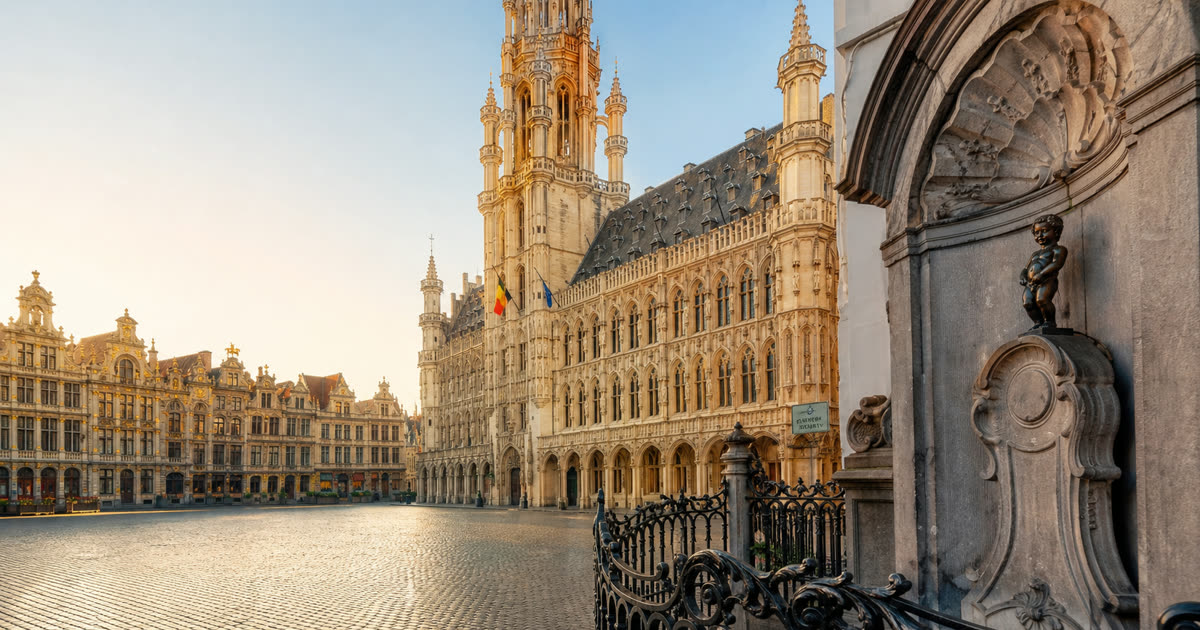
The Grand Place is the central square of Brussels, surrounded by the guildhouses the Hôtel de Ville and the Maison du Roi. It has been a UNESCO World Heritage Site since 1998 and is considered one of the most beautiful squares in the world. The construction of the new town hall, in several phases between 1401 and 1455, transformed the square into the seat of municipal power. Opposite the town hall, the old bread market, later known as the Maison du Roi, lost its commercial function in 1406 and was converted into a place of justice. In 1695, the cannons of the French army destroyed most of the buildings on the square. They were completely rebuilt, with the exception of the town hall, in less than four years. What you see today is therefore a late 17th-century Baroque complex, built in haste, in competition between the guilds, to reassert the city's mercantile power after the French devastation.

Plays on location, in the app
3

Grand Place

56s

At the beginning of July, the Grand Place hosts the Omegang, one of the greatest historical pageants in Europe. It features a lavish procession in period costume of over 1,400 participants, commemorating a similar event that took place in 1549, in the presence of Emperor Charles V, his sister Eleanor of Habsburg, and his son Philip II of Spain. Every even year, on the weekend of 15 August, the Feast of the Assumption, the Grand Place is covered by an immense flower carpet, 25 metres wide and 75 metres long, made from more than 500,000 begonia plants. In 1856, a monumental fountain was installed at the centre of the square, to commemorate the 25th anniversary of the reign of Leopold I. The Grand Place is therefore a square that continues to be used, not merely contemplated. It has hosted coronations, executions, markets, protests and flower carpets without interruption for six centuries.

Plays on location, in the app
4

Hôtel de Ville Bruxelles

51s

The Hôtel de Ville was built between 1402 and 1455. The original architect was probably Jean Bourneuil. The tower, dating from 1454 and built in Gothic style, was designed by architect Jan van Ruisbroek. At its summit stands a statue of the Archangel Michael, patron saint of Brussels, battling the devil, a work of 1454 by Martin van Rood. The tower stands 96 metres tall, and is not centred on the façade. Construction began on one side before the final dimensions of the building were decided. The tower therefore ended up asymmetrical with respect to the façade. A popular legend holds that the architect, realising his mistake, threw himself from the tower. This is not documented, but the tower is genuinely off-centre with respect to the façade, and this is verifiable with the naked eye.

Plays on location, in the app
The full story plays on location, in the appLocation-based audio on Voxter
Get Voxter